Twenty years ago, spotting a falcon on a city rooftop felt like a small miracle. Today it is the new normal: in Beijing, Shanghai and every major city, people look up and see a small raptor perched on a ledge, a lamp pole, even an air conditioner unit. The city seems to be filling with falcons — and that is exactly what is happening.
The obvious guess is that falcons are victims of habitat loss, squeezed into the concrete jungle because the wilderness is gone. The answer is the opposite. Cities are not a slum falcons tolerate. For falcons, the modern city is paradise — and they moved in eagerly.
The City Is, Surprisingly, Falcon Country
How many falcons actually live in cities? The number is startling: roughly 15–25% of the entire falcon family population now lives in urban areas, and in Europe the share reaches as high as 40%.
To feel how big that is, remember what falcons are. Most falcon species are specialists of wilderness — steppe, desert and rainforest. Cities provide none of those environments, and such species simply cannot survive there. Once you subtract all the falcons that physically cannot live in a city, the proportion that does is even more remarkable.
Across all raptors, falcons hold first place in urban living. The family outranks even the owls (Strigiformes), which most people would pick as the archetypal city raptor, in the share of species that have made it in town.
They Don't Even Need a Nest
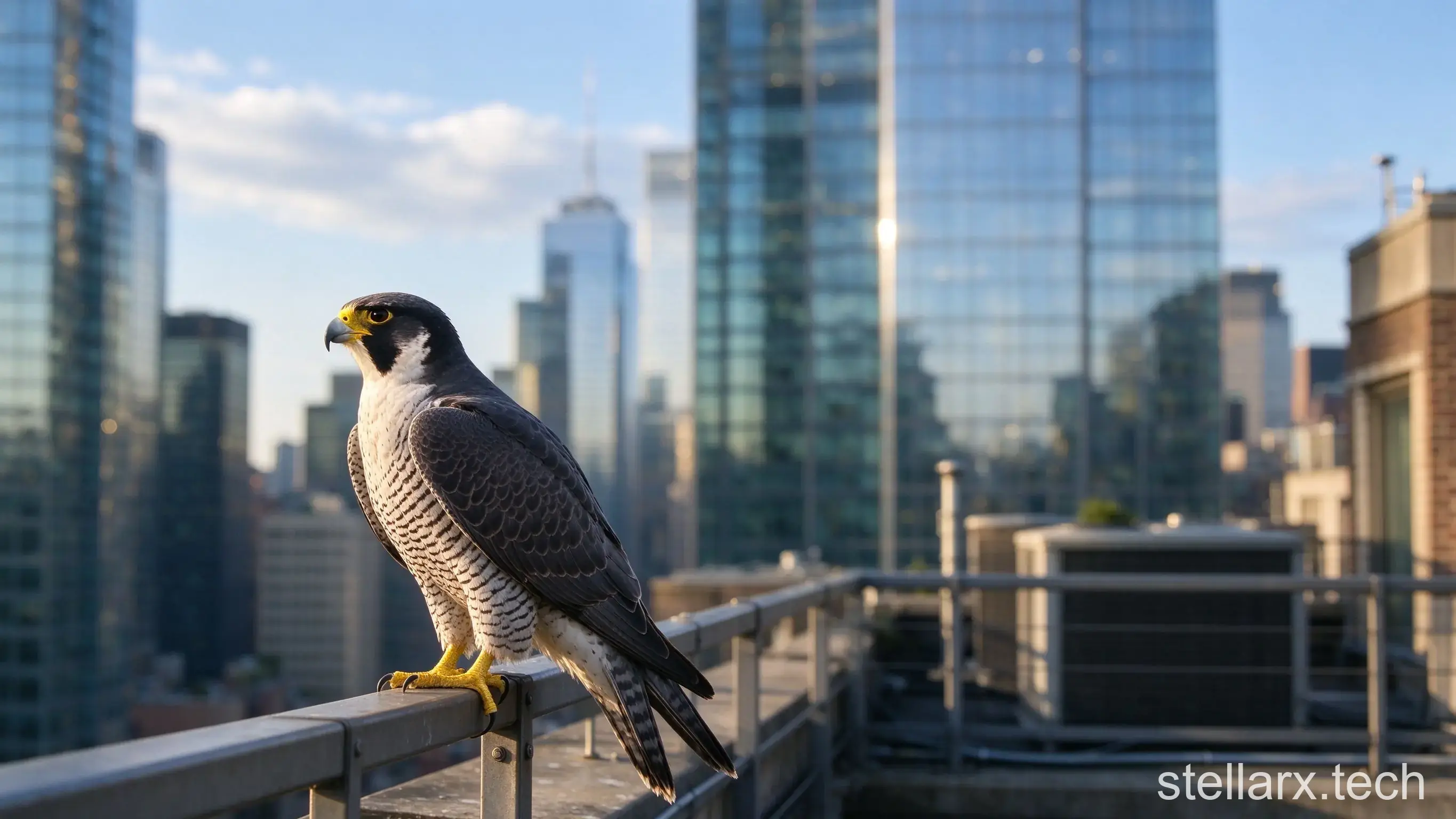
Here is the twist: skyscrapers are not what falcons would choose first. In Beijing, birdwatchers crowd the shore of Yuyuantan Lake every year to photograph the Eurasian hobby that nests there — not on the buildings, but on an abandoned lamp pole tens of metres tall that stands in the lake. For a hobby, that pole is the ideal nest site. Only because not every city has that many large urban parks do falcons "make do" with rooftops.
The deeper reason is that falcons barely build nests at all. A falcon will lay its eggs on a small ledge in the middle of a cliff, a fork in a treetop, the top of a lamp pole, a rooftop platform, even an air conditioner unit. The bar is simply: can the eggs hatch there?
Every one of those spots shares one property. Land predators cannot reach them. And medium-sized local birds like crows and magpies will not fight over a patch of "nest" that has no actual nest structure to claim. European and American zoologists have observed that urban falcon chicks actually survive better than their wild counterparts.
An All-You-Can-Eat Buffet
As small raptors, falcons feed mainly on small mammals — mostly various mice and rats — plus small and medium birds, reptiles and insects. Cities are a nonstop supply of all of them.
People living in apartments rarely realise how many rodents surround us. Estimates put the house mouse population of just the six central districts of Beijing at 2 to 6 million. For a falcon population that is limited in number, that is an unlimited food court.
The Skyscraper Is a Fortress
There is one more reason falcons prefer high office rooftops: the big predators are not welcome.
Large raptors — the eagles, hawks and owls of the Accipitriformes — either dare not enter the city core or are simply not used to it. And animals like raccoons, coyotes, foxes and snakes? Whether or not they could climb to the roof, they cannot get into an office building at all.
So whether out of wildlife protection or by accident of architecture, humans have become the security system that keeps falcons safe in the city. Falcons did not reluctantly adapt to urban life — they could hardly wait to accept it.

The One Real Enemy: Glass
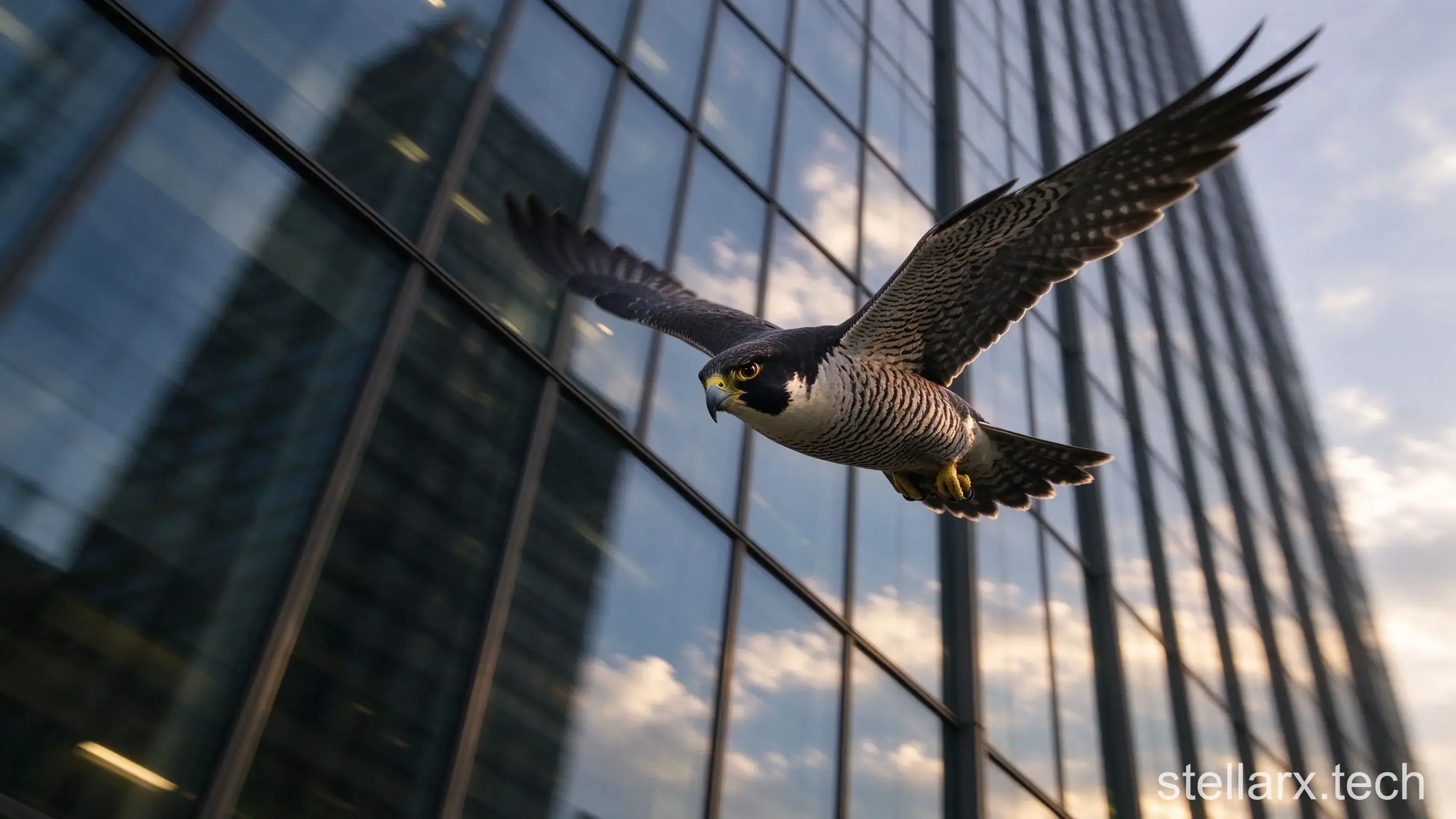
Nothing is free, and for city falcons the price of paradise is glass. The biggest threat to falcons in cities is the mirror effect of glass curtain walls. To a flying falcon, a glass facade can look like open sky.
The Beijing Raptor Rescue Centre regularly takes in falcons injured by window collisions, and during the breeding season juvenile birds hitting glass are especially common.
But falcons get off relatively lightly compared with other birds. Falcons have outstanding vision, so they are less likely to misjudge glass and sky. And they rarely hunt at the same horizontal level — because of their small bodies, falcons dive at high speed to gain kinetic energy before striking prey, so their hunting is dominated by steep stoops rather than level chases. Adult falcons hit windows less often, at a rate the species can live with.
The Plot Twist: Falcons Are More Parrot Than Hawk
Here is a piece of taxonomy that surprises almost everyone. In traditional classification, eagles, buzzards, harriers and falcons were all packed together into one order, the Falconiformes. But modern molecular biology has shown that falcons, genetically, are not like hawks at all — they are closer to parrots.
The family tree has been rewritten: today the order Falconiformes contains only the falcon family. All the other birds of prey were moved into the Accipitriformes (the hawk order). The falcon on your office tower is, in an evolutionary sense, the parrot's cousin living a raptor's life.
The Laws of City Living
Falcons are not the only ones who noticed that cities suit small, fast, low-cost predators. One observer compared urban falcons to the millions of driven young workers who move to first-tier cities to take exams and take jobs: small body, small living costs — a pigeon is a treat, a mouse or rabbit a proper meal, and when the menu is thin they are willing to make do with insects, geckos and lizards, where the bigger eagles would rather starve than lose face.
Falcons are more atomised than flocking crows and magpies, and get bullied by corvid gangs — but they do not mind communal roosts when the mood takes them. They ride updrafts between tall buildings for kilometres, using the towers as public transport. And their childhood is the classic raptor path: brutal, competitive, high-cull — by the sub-adult stage the survivors have basically clawed their way out.