That bear in the photo is not pulling a cart. It is pulling a tapeworm — and it has been harnessed to it.
The story opens with a huge bear roped and straining against a long pale line. That line is the real payload: a broad fish tapeworm (Diphyllobothrium latum), the tapeworm that lives in raw and undercooked fish. A bear can drag ten meters of it. A human, being smaller, drags a shorter specimen — which is why the man in the news, a regular raw-fish eater, passed a tapeworm measured at 4.5 meters and still growing.

Why a Tapeworm Can Grow 4.5 Meters Long
Can you get parasites from eating raw fish? Yes — and the fish tapeworm is the textbook answer, because its length is not a freak accident. It is factory default.
Adults of Diphyllobothrium latum normally run 4 to 6 meters in a human intestine. That 4.5-meter worm from the news was not exceptional; it was average. The only limit is host size. A bear's gut is longer, so a bear can host a worm past 10 meters. Same species, same worm — the tapeworm simply grows to fill the space it is given.
A Tapeworm Is a Stack of Miniature Worms
The next image makes the length easier to grasp. A tapeworm is basically a cactus: every little segment along the body is a miniature, stripped-down version of the whole animal.
Each proglottid carries its own reproductive machinery. The worm has no mouth, no anus, and no gut. Nutrients and waste diffuse straight through the body surface — every segment is its own eating-and-excreting unit, living wall-to-wall with its copies. Detached segments can even survive on their own. A 4.5-meter worm is not one long animal so much as thousands of short ones standing in line.

How Raw Fish Delivers a Tapeworm
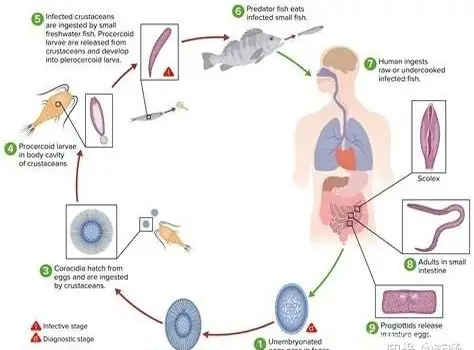
The life cycle runs through fresh water, and every stage is a closed loop:
Step 1 — eggs into fresh water. Eggs leave the host in feces and reach fresh water.
Step 2 — a copepod swallows an egg. The copepod is the first intermediate host; inside it, the larva develops.
Step 3 — a freshwater fish eats the copepod. The larva burrows into the fish's muscle as a plerocercoid.
Step 4 — a human eats the fish raw or undercooked. The larva settles in the small intestine and grows into a 4–6 meter adult.
Humans are the definitive host. We are the end of the line: the worm matures in us, mates in us, and drops eggs into our feces to restart the cycle.
Treatment: Find the Scolex, Bothria and All
Treatment is one drug: praziquantel, the first-line anthelmintic. It works by a neat trick.
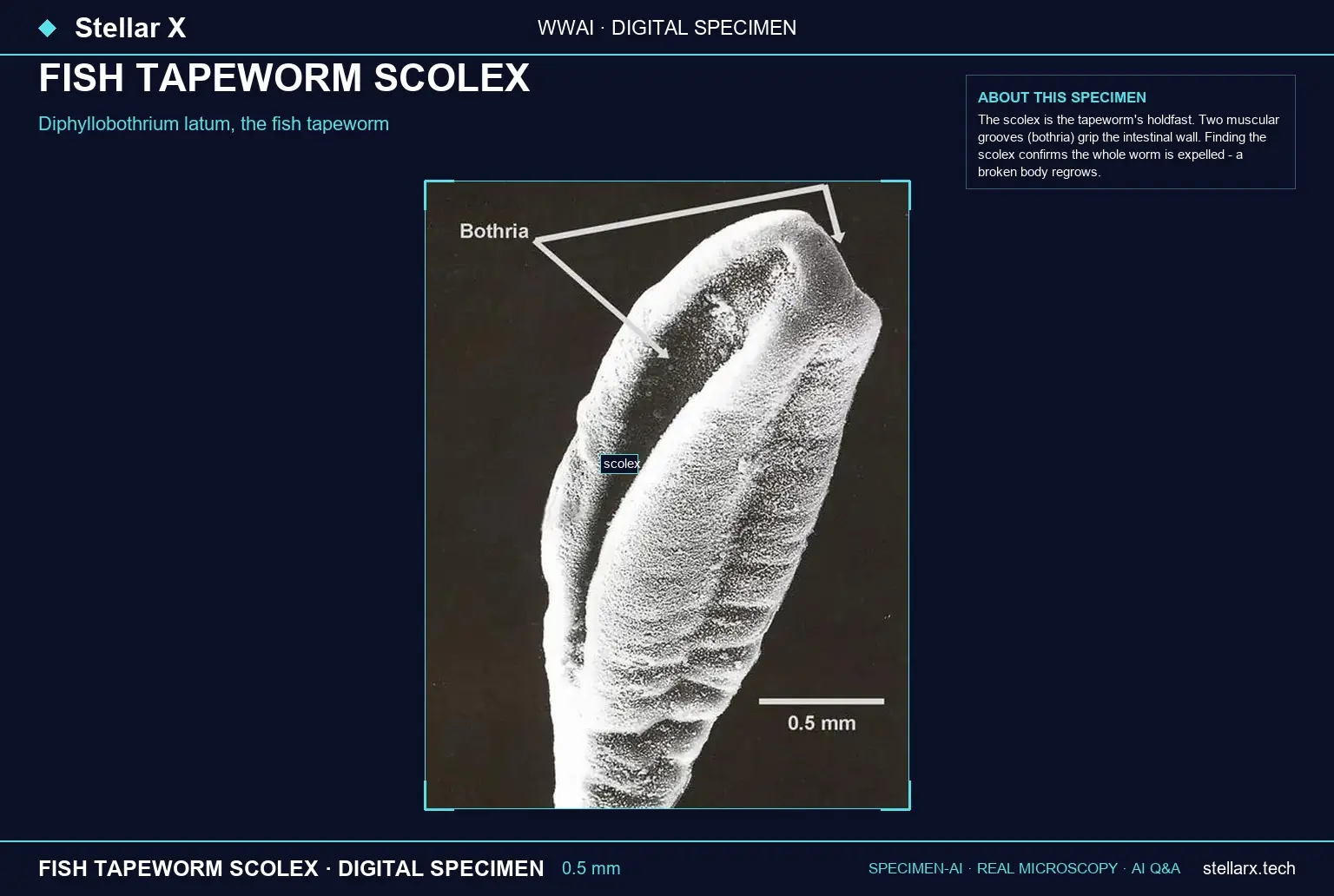
Praziquantel opens calcium channels in the worm's muscle. Calcium floods in, the muscle locks into a rigid spasm, and the scolex — the head, with its two muscular grooves called bothria — loses its grip on the intestinal wall. The whole worm slides down the gut and out.
The hard part is confirming the job is done. Only finding the scolex proves the entire worm is gone; a broken-off body can regrow. That is why the doctors in the news patiently reassembled the 4.5-meter worm piece by piece, and why follow-up stool checks for eggs matter — the head is small and easy to miss among the segments.
Prevention: Cook the Fish. That's It.
Prevention has exactly one method that works: cook the fish through.