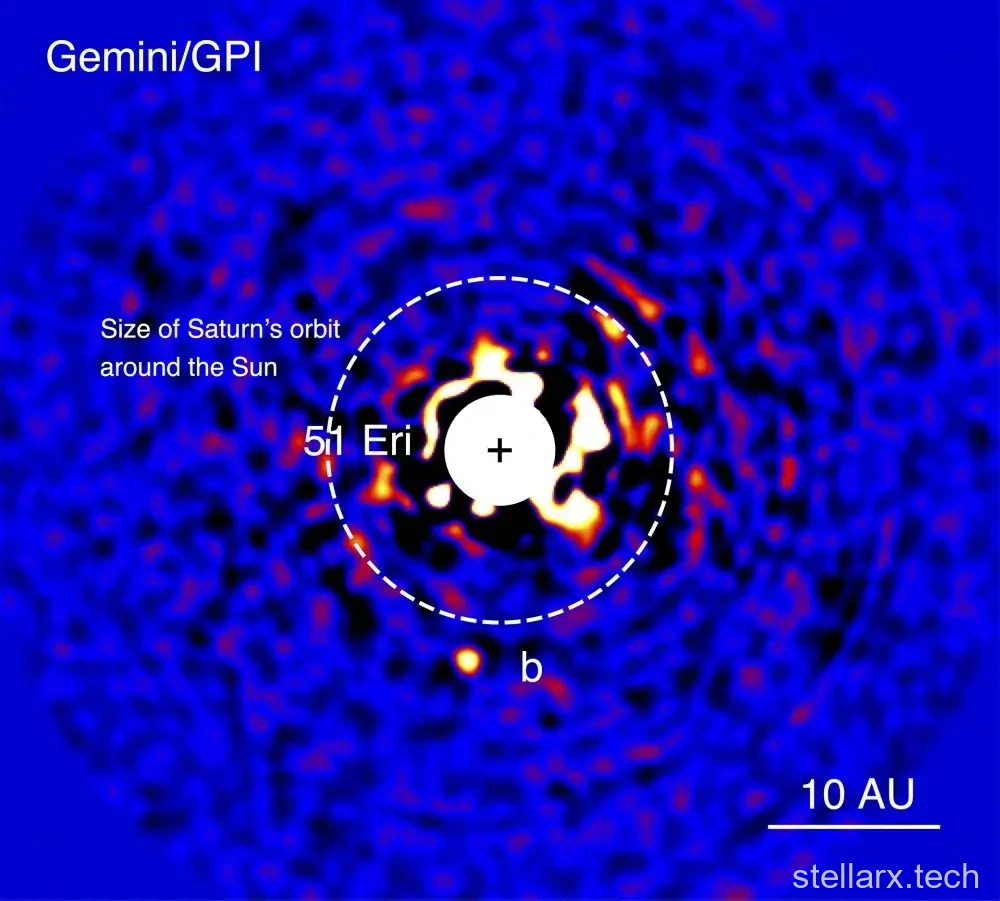
Exoplanets would be a lot easier to find if so many of them weren't so close to their stars. But they are, and that's something exoplanet scientists have to contend with. Coronagraphs do great work blocking out starlight and making dim planets more visible, but they have their limitations.
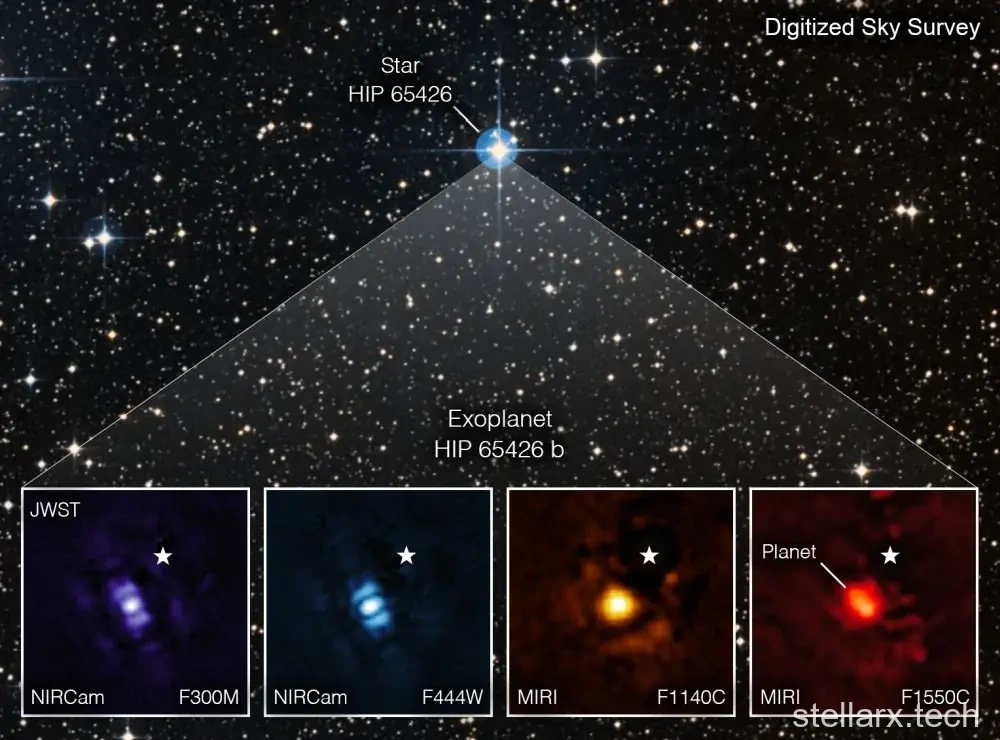
JWST has coronagraphic capabilities embedded in its NIRCam (Near-Infrared Camera) and MIRI (Mid-Infrared Instrument). Those capabilities have helped the telescope study some tough subjects hidden in the glare of stars, debris disks among them, and to observe extremely luminous objects like quasars.
But all telescopes have a stability limit, even the steady-eyed JWST. The stability limit is a threshold beyond which mechanical, thermal, or optical fluctuations make clear images impossible. JWST has fine guidance sensors and a 5-layer sunshield to raise this threshold, but the limit is still there.
New research in Nature explains how astronomers developed a way to subtract more starlight from JWST's observations and image exoplanets that are up against the telescope's limits. It is titled "Imaging exoplanets below the telescope stability limit," and the lead author is Rodrigo Ferrer-Chavez, a graduate student in the Department of Physics & Astronomy at Northwestern University.
"Exoplanet imaging is the main method for detailed characterization of planets orbiting beyond 1 au (astronomical unit) but it requires suppressing the bright glare of the star to see the faint planet light," the authors write. Suppressing that glare requires a couple of things, including extremely stable telescopes.
"We try to make telescopes extremely stable, but there are extreme engineering challenges that we haven't quite solved yet," said study co-author Jason Wang, assistant professor of physics and astronomy at Weinberg College of Arts and Sciences at Northwestern. "There are known causes of instability and unknown causes. Small thermal changes could cause a mirror to expand or contract by a picometer. Telescopes like JWST have cryocoolers to keep the instrument super cold. Those coolers have little motors that can cause the mirrors to vibrate. So, there are issues like those, but also issues that we still don't understand as we learn how to build these complex telescopes."
But a stable telescope is only part of the picture. Image processing plays a huge role in modern astronomy, and the two factors, telescope stability and image processing, play into each other.
"As well as sophisticated instrumentation, effective image processing is necessary for starlight suppression, which continues to be a substantial limitation," the authors write.
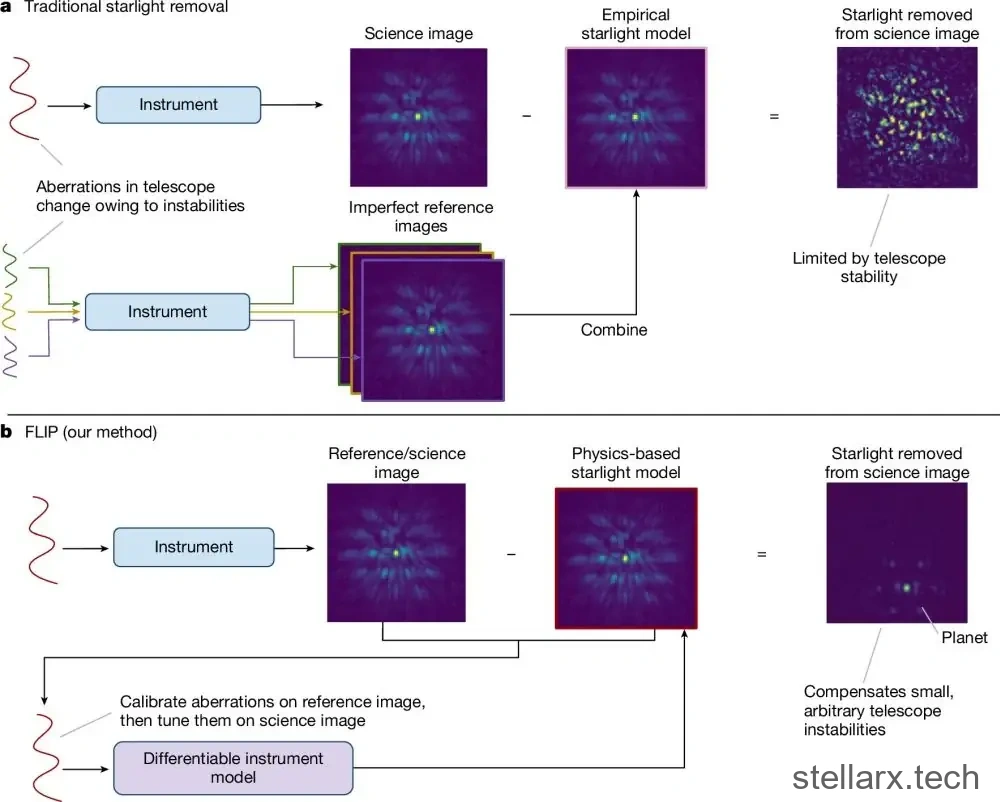
There are standard algorithms that astronomers employ to overcome this limitation, including using reference images to model starlight.
"For the past 20 years, astronomers have tackled this problem by observing a different star and using its image as a reference," said Wang. "Then, they subtract that reference image from the original observation to remove the unwanted glare to reveal faint planets that otherwise might be hidden."
But reference images have their limits too. That method still suffers from the inevitable instabilities in a telescope that arise when switching from a reference image to an actual observation. Overcoming these stubborn obstacles will mean we can directly image more exoplanets.
"Addressing this challenge will increase the number of planets amenable to direct imaging and will be a notable step towards imaging exo-Earths with future observatories," the researchers explain.
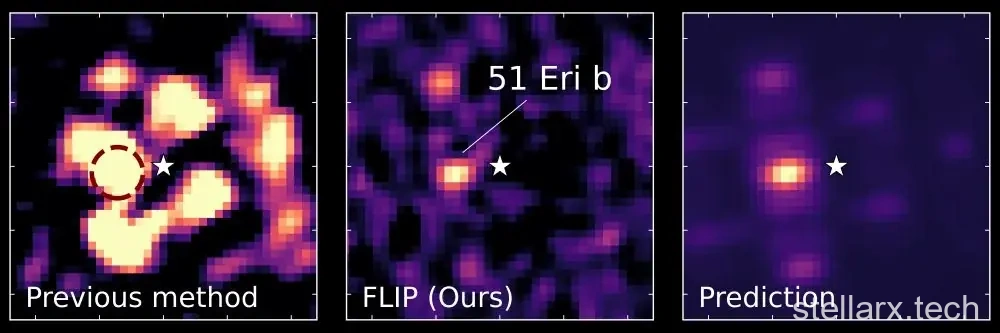
Their answer is a new method based on physics and modelling that also borrows ideas from machine learning. It can account for JWST's tiny, nanoscale imperfections. The method lets astronomers subtract starlight from images more effectively than ever before.
"Planets are a million times fainter than their stars," said lead author Ferrer-Chavez. "So, to image exoplanets, we need to remove that glare. That is a very tricky problem because even the tiniest changes in the telescope can affect how that glare appears. Slight shifts or tilts — even on the scale of just a few nanometers — can change the pattern of light. Our method models how light travels through the telescope and accounts for those tiny changes, allowing us to remove the glare much more precisely."
This comes down to PSF, the point spread function. Every telescope detects light imperfectly. They all distort or bend light in some way. So instead of a point source appearing as a point, it inevitably is degraded somehow. That can hide extremely dim sources like exoplanets in the glare of their stars. Accounting for PSF is a work-a-day part of astronomy.
The new system is called FLIP, for Physics-based Learning for Imaging Planets, and it overcomes the problem of switching from reference images to real observations. FLIP "incorporates a multistep optimization strategy with a flexible physical model informed by wavefront sensing data to achieve the PSF fidelity necessary for real data," the authors write.
That is more technical detail than many will find interesting. But this type of work is behind the gorgeous images and fascinating discoveries in astronomy.