Are Baguettes Really Supposed to Be That Hard?
When people talk about baguettes online, jokes about their hardness are everywhere.
Some people knock them against tables, while others joke that a day-old baguette is hard enough to become a “French self-defense weapon.”
That naturally raises a question for anyone trying one for the first time:
Are baguettes actually supposed to be this hard?
Not exactly.
A properly made fresh baguette should have a noticeably crisp crust, but the inside should not feel like a rock.
The ideal texture is:
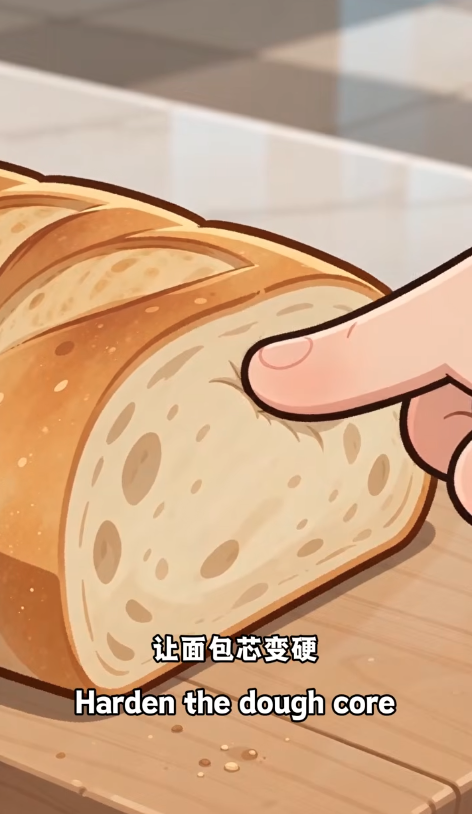
crispy on the outside, soft and chewy on the inside, with plenty of irregular air pockets.
So if your baguette is difficult to bite all the way through, there is a good chance it is simply no longer fresh.
A Traditional Baguette Uses Surprisingly Simple Ingredients
Despite its distinctive appearance, a traditional baguette is made from remarkably simple ingredients.
At its core, it relies on:
flour, water, salt, and yeast or a natural starter.
Unlike many soft breads, baguettes do not depend on large amounts of butter or sugar to create richness and tenderness.
Because the ingredient list is so simple, factors such as flour quality, hydration, kneading, fermentation time, shaping, and baking become especially important.
In other words:
The simpler the ingredients, the more important the technique becomes.

Much of a Baguette’s Flavor Comes From Time
A good baguette is not simply flour and water mixed together and immediately placed in an oven.
Fermentation plays an essential role in developing both structure and flavor.
After yeast or starter is added, the dough ferments under controlled conditions.
During this process, gases are produced, helping create the open internal structure of the bread. At the same time, fermentation contributes to the development of more complex aromas and flavors.
That means a good baguette is about much more than whether the crust is crunchy.
Its appeal also comes from:
the aroma of wheat, fermentation notes, roasted flavors, and the contrast between the crust and the interior.

Why Are There So Many Irregular Holes Inside a Baguette?
Slice open a well-made baguette and you will notice that the inside does not have the fine, uniform texture of a cake or soft sandwich bread.
Instead, it often contains air pockets of different shapes and sizes.
These holes are related to the dough’s hydration, gluten structure, and the gases produced during fermentation.
As fermentation progresses, gas becomes trapped within the gluten network.
When the dough enters the oven, the trapped gases and water vapor expand further, leaving behind the characteristic open crumb.
So those seemingly irregular holes are actually an important part of a baguette’s structure.

Why Does a Baguette Develop Such a Hard, Crispy Crust?
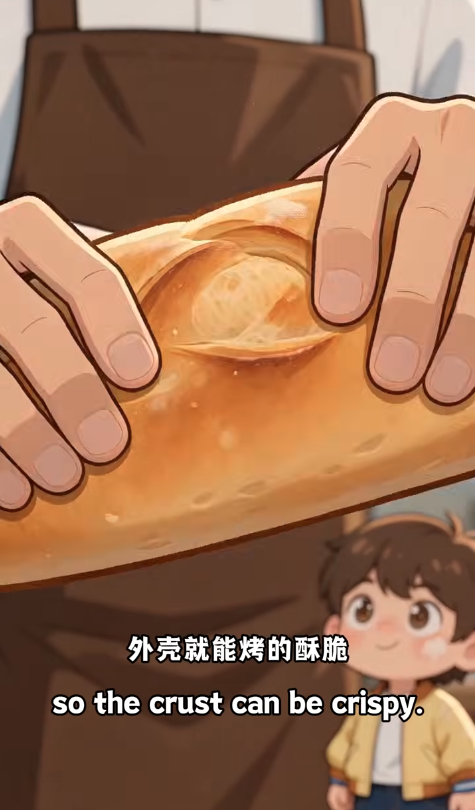
One of the baguette’s most recognizable features is its golden, crunchy crust.
That crust is closely connected to what happens inside the oven.
As the dough is exposed to high heat, moisture gradually evaporates from the surface.
At the same time, browning reactions take place, producing the baguette’s golden color and rich baked aroma.
But there is another important part of the process:
steam.

Why Is Steam Used When Baking Baguettes?
One important baking technique highlighted in the video is:
Do not let the surface become hard too early.
If the dough surface dries out and sets immediately after entering the oven, it can restrict the bread’s ability to expand.