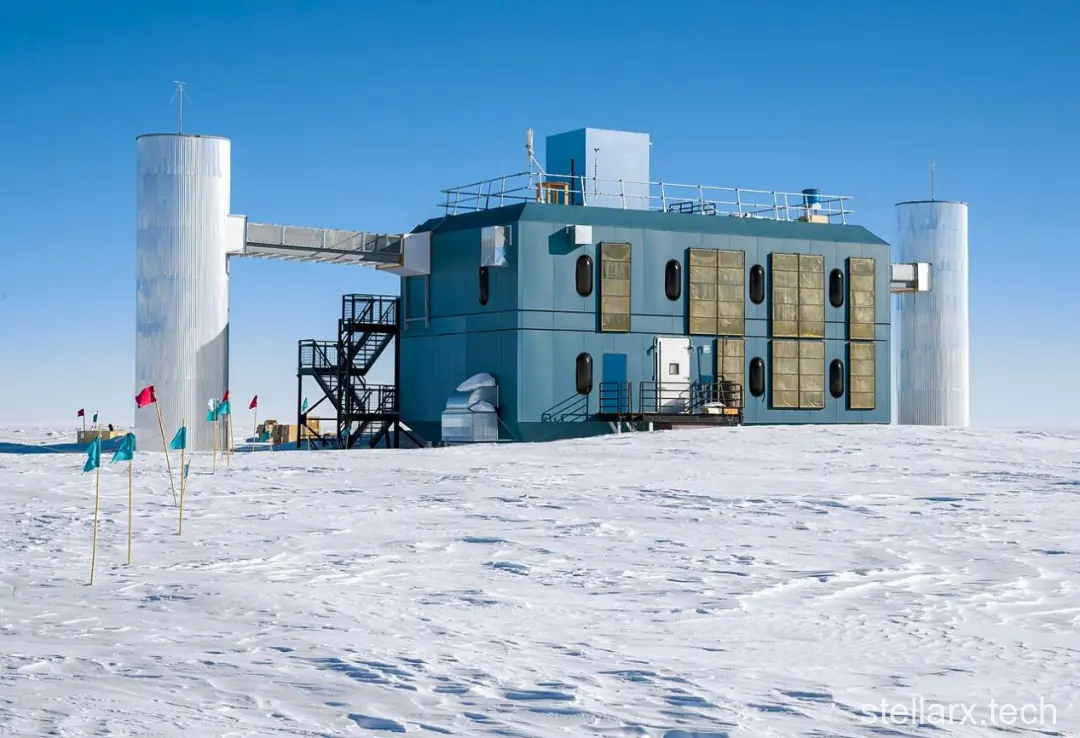
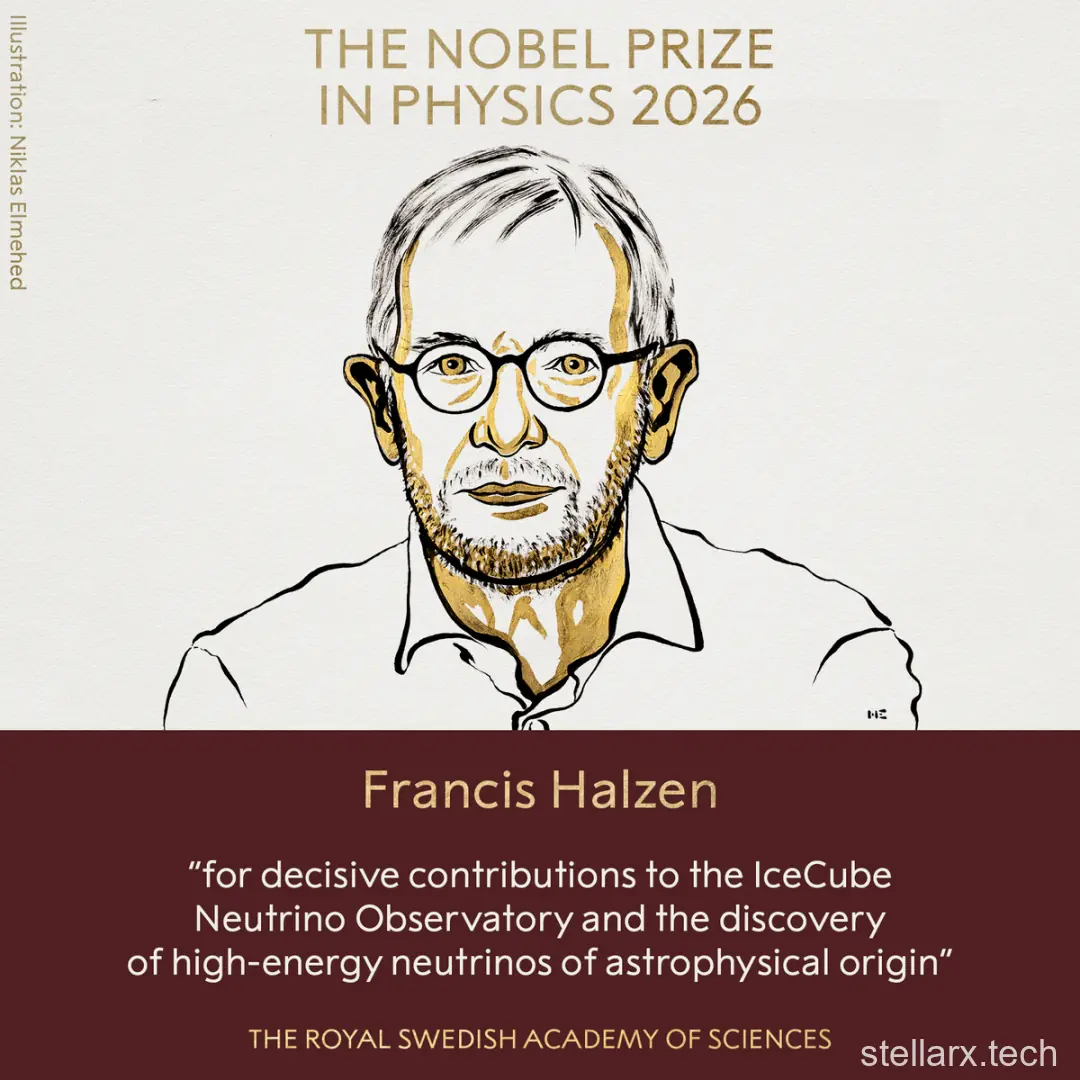
At 11:45 a.m. on October 6, 2026, Stockholm time, the Royal Swedish Academy of Sciences announced the 2026 Nobel Prize in Physics. The winner was Francis Halzen, honored for his decisive contributions to the IceCube Neutrino Observatory and to the discovery of high-energy neutrinos of astrophysical origin.
The neutrino is a particle so small that it hides the deepest secrets of the entire universe inside itself. What exactly is the IceCube Neutrino Observatory? And why do high-energy neutrinos matter? This is the story of the man who dug ice, moved mountains, and found a Nobel Prize.
A "Ghost Particle" That Lived in Predictions
As early as 1930, the physicist Wolfgang Pauli predicted the neutrino's existence. At the time, experiments showed that during beta decay, energy inside atomic nuclei seemed not to be conserved — some beta particles came out with slightly more energy, some with slightly less.
To explain this, Pauli made a bold assumption: in beta decay, besides electrons, some particles invisible to human observation were also produced, carrying away part of the energy. That was why energy looked non-conserved.
That particle was the neutrino. We cannot observe it easily because its mass is tiny, it carries no charge, and it almost never interacts with matter — which is why ordinary methods struggle to detect it.
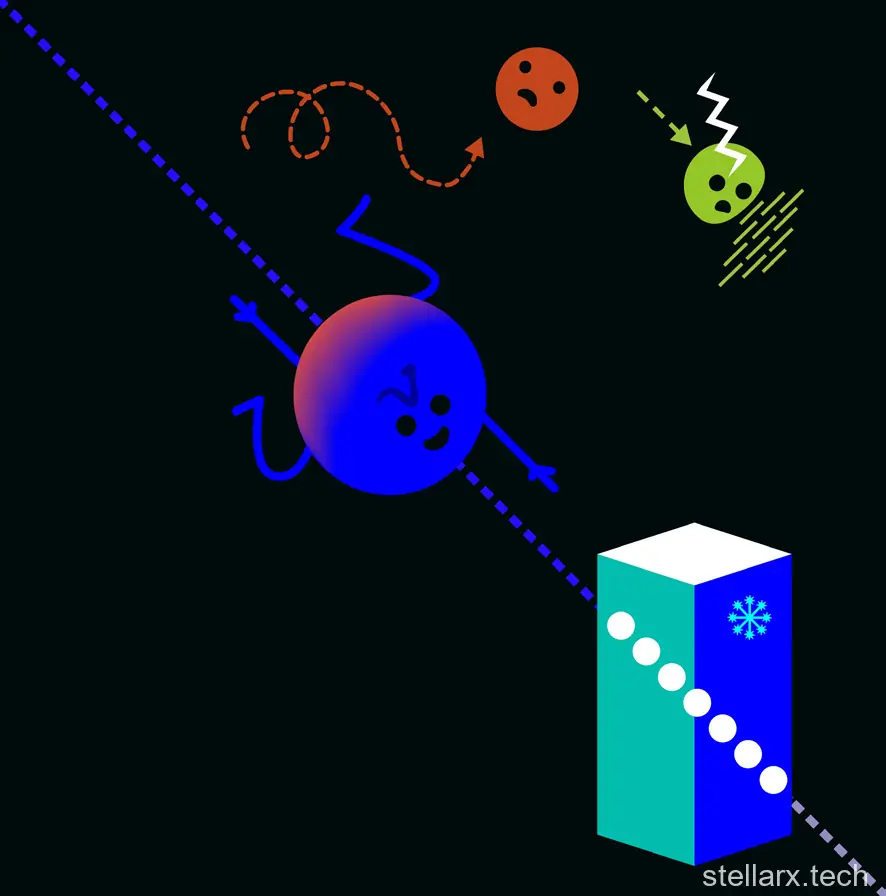
This is also why many people call neutrinos "ghost particles." In fact, neutrinos from the Sun are bombarding Earth at a terrifying density — about 1,000 trillion neutrinos pass through your body every single second, and you never notice a thing.
It was not until 1956 that the American physicist Frederick Reines and his collaborators first forced this "ghost" to reveal itself with an ingenious method. He received the 1995 Nobel Prize in Physics for it. (One aside: Reines's collaborator Clyde Cowan had already passed away before the prize was awarded — so if you want a Nobel, stay alive.)
The Universe's Messengers
So what do neutrinos have to do with the universe? To see the universe clearly, you have to learn to read the information streams arriving from space. Before neutrinos, humanity received cosmic messages through three main channels:
The first is visible light — what human ancestors could already see. Look up on any clear day and you see the Sun, the Moon, the stars. But visible light is blocked by interstellar dust; it cannot reach the depths of the universe.
The second is electromagnetic waves such as gamma rays. These too are absorbed by interstellar matter, and they decay along the way.
The third is cosmic rays, discovered in 1912. These are essentially streams of high-energy particles. Because they usually carry charge, they are deflected by the magnetic fields of interstellar space during their journey, making their origins impossible to trace.
Once the neutrino's existence was confirmed, physicists immediately fixed their attention on the high-energy neutrino streams of the cosmos. As mentioned, neutrinos carry no charge and barely interact with other matter — their paths are almost completely undisturbed by anything in interstellar space.
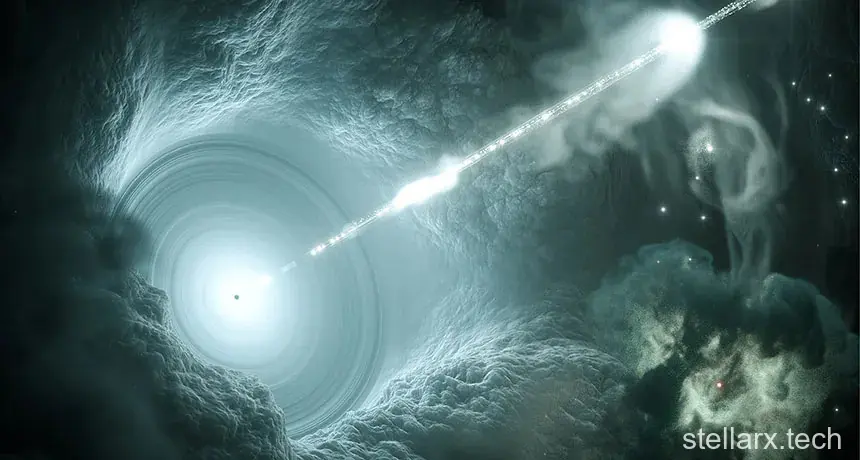
That means if we can catch a neutrino, we can trace its trajectory back to where it started and "see through" the celestial object that produced it. It is like receiving a letter from a distant part of the universe with perfect precision. Capturing high-energy cosmic neutrinos became the dream of every astrophysicist.
The Enticing Blue Light Underwater
Neutrinos are hard to catch, but not completely invisible. When one occasionally interacts with matter, it produces charged particles — for example, electrons, and muons (particles similar to electrons).
Because cosmic neutrinos are extremely energetic, the charged particles they produce move at incredible speeds. The problem: these particles vanish in an instant. The key to experiment design was catching them before they disappeared.
Scientists hit on a method: Cherenkov radiation. This radiation is a bit like the Mach cone produced when a supersonic aircraft breaks the sound barrier.
When a plane flies faster than the speed of sound in air, the sound waves get "pushed along" by the plane, forming a cone-shaped wavefront behind it.
Similarly, when a charged particle moves faster than the speed of light in a medium, it drags the medium's electromagnetic field along with it, forming a cone-shaped light wavefront behind the particle. That is Cherenkov radiation.
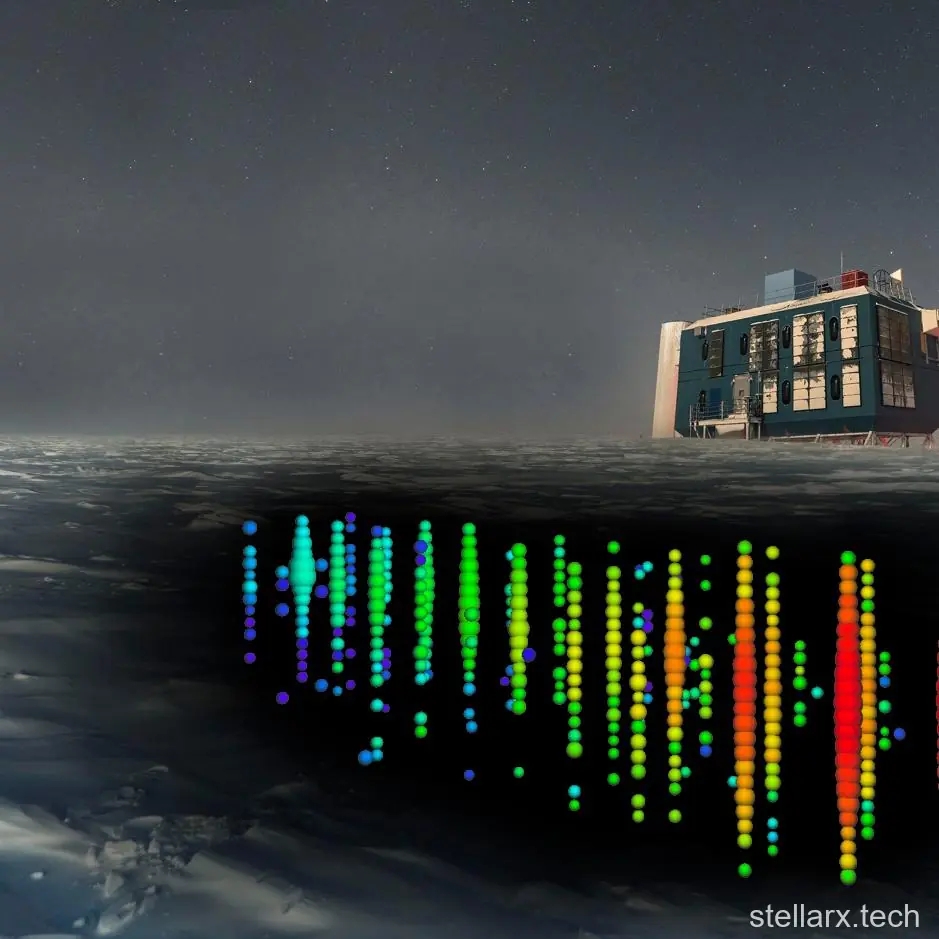
When we detect this radiation, we can work backward to the direction of the charged particle — and since that particle was produced by a high-speed neutrino collision, its direction points back to where the neutrino came from. A perfect closed loop.
But wait — physics teachers say the speed of light is the fastest speed in the world. How can anything exceed it?
Here is the trick: the qualifier is "the speed of light in a medium." Light in a vacuum cannot be beaten, but in water or ice, light slows down dramatically. So a charged particle can exceed the speed of light in that medium, producing Cherenkov radiation.
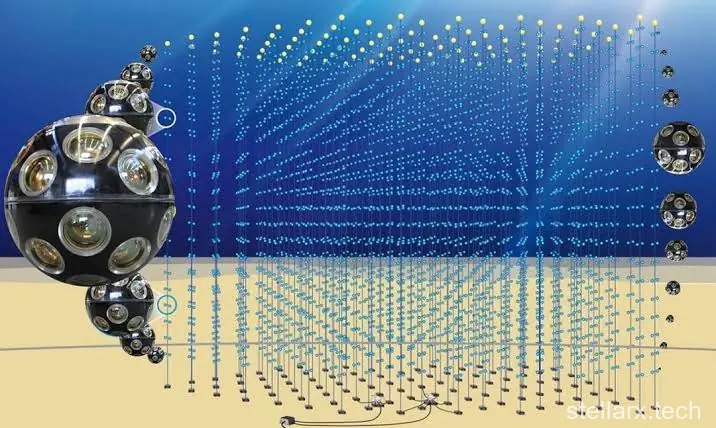
In other words: put your experiment in water or ice, and you can catch high-energy neutrinos through Cherenkov radiation.
Still, the neutrino is unimaginably small. The probability that one hits an atomic nucleus as it crosses water is extremely low. To give a rough sense: it is like randomly throwing one grain of rice somewhere in the solar system and having it land exactly on another grain of rice.
To collect enough neutrino interactions and accumulate enough signals, physicists need an enormous volume of detection medium. So they naturally looked to the ocean: place detectors on the seafloor and use the huge mass of seawater itself. Today, experiments like KM3NeT sit deep in the Mediterranean.
A Secret Base Sealed in Polar Ice
Readers may be getting impatient — where is Halzen in all this? Don't worry; heroes appear at the most crucial moment.
Water works, and the ocean offers volume in abundance. But it has obvious drawbacks: ocean currents, radioactive backgrounds, and even fish that glow in the dark!
Halzen thought of another medium: Antarctic ice.
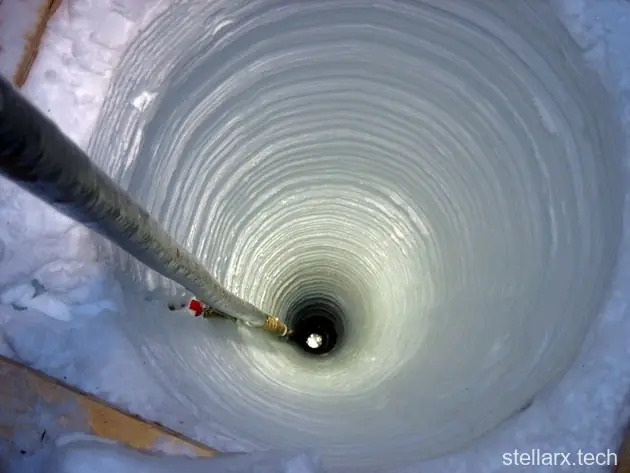
To be fair, scientists had considered ice. Ice has several enticing advantages: it is quiet, transparent, free of biological interference, and once formed it barely flows. Antarctica's deep ice lies buried far below the surface, shielding it from surface interference and letting scientists "listen to the sky" undisturbed.
The problem was that lab measurements of ice transparency showed bubbles and impurities scatter light severely, attenuating the Cherenkov signal badly.
Moreover, ice at this scale exists only in Antarctica, and building such a massive project there — even if it could be finished — would be a maintenance nightmare. Scientists once believed that using ice for a neutrino detector was pure paper talk.

You can see this for yourself with an ice machine: water freezes and traps air, so ice cubes are never perfectly transparent.
But Halzen insisted ice would work. To be fair to the skeptics, even Halzen later admitted: "If I hadn't been completely ignorant of the optical properties of natural ice, I would have opposed this plan too."