A whale that dies at the surface does not simply sink and disappear. It falls — sometimes for hours, through a kilometre or more of water, until a body the size of a bus lands on soft abyssal mud. What happens next has been studied for only about four decades, and it is one of the strangest food webs on the planet: a supply of energy dropped into a place that has no sunlight, no plants and almost nothing to eat. The carcass feeds a succession of communities for years, and then its bones feed another one for decades.
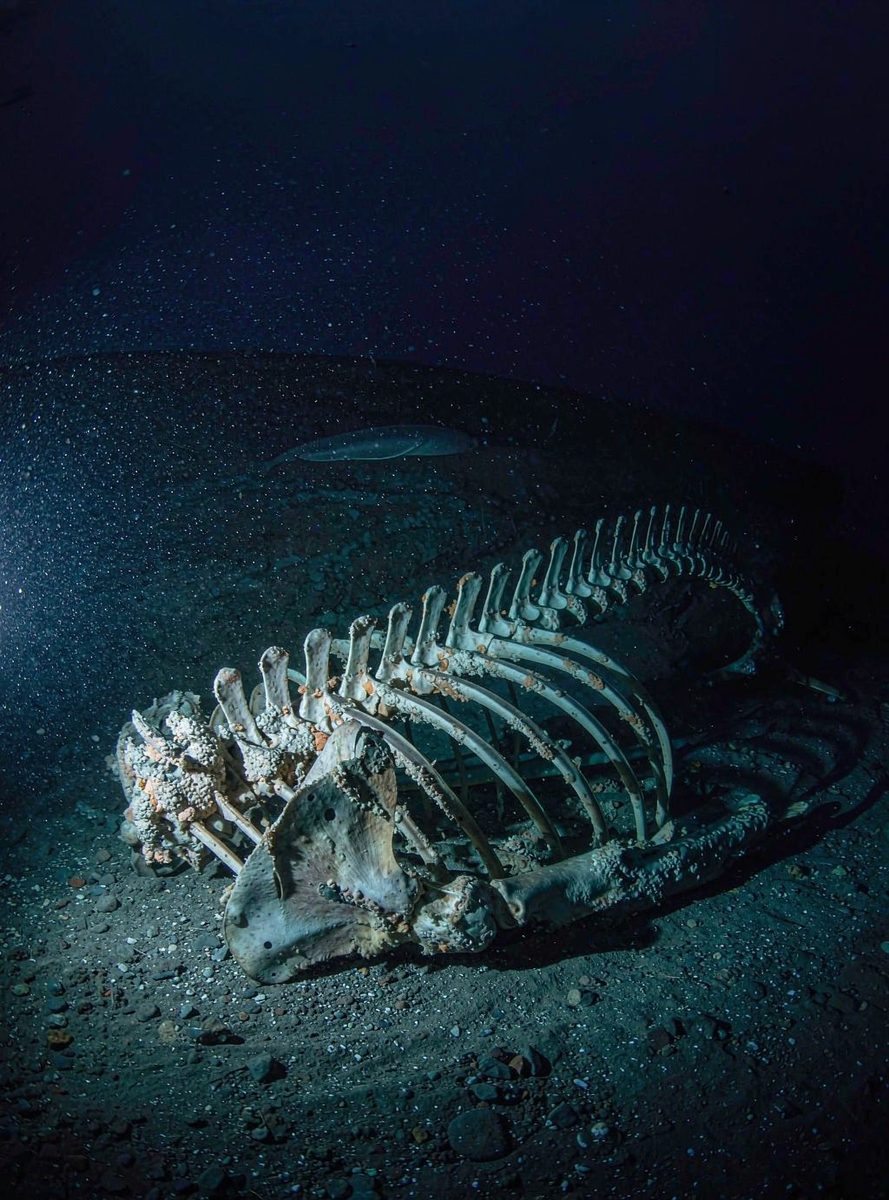
Stage one: the scavengers arrive
The first response is fast and unglamorous. Hagfish, sleeper sharks, rat-tail fish, crabs and swarms of amphipods detect the body and strip it. Estimates put the soft tissue removal at more than ninety percent within a few months to a year, depending on the size of the whale; a large carcass takes longer, a small one is cleared quickly. What is left is a skeleton, often still articulated, because deep water has little current to scatter it.
This stage is the one that looks like ordinary decomposition, and it is the reason whale falls were not recognised as a distinct phenomenon for a long time. The interesting part is what the carrion leaves behind.
Stage two: the opportunists
Once the flesh is gone, a second community moves in on the enriched sediment around the bones. Polychaete worms, snails, small crustaceans and bivalves colonise the area, feeding on organic fragments that have soaked into the mud rather than on the carcass itself. Densities around a whale fall can be orders of magnitude higher than on the surrounding seafloor, which is why the site is sometimes described as an oasis.
This stage lasts months to a couple of years. Its residents are mostly generalists — species that also turn up at other organic windfalls — and they are the reason a whale fall functions as a stepping stone. A deep-sea larva that finds a whale fall can survive and reproduce in a place that would otherwise be empty, then release offspring that may reach the next one.
Stage three: chemistry replaces sunlight
The third stage is the one that changed how biologists think about deep-sea ecosystems. Whale bone is not just mineral. Roughly sixty percent of its mass is lipid, and that fat is the fuel for a microbial process that works without oxygen and without light. Anaerobic bacteria in the bone use sulfate from seawater to break down the lipids, and the by-product is hydrogen sulfide — the compound that gives rotten eggs their smell.
A second group of bacteria oxidises that sulfide with dissolved oxygen and uses the energy to fix carbon, exactly as plants use sunlight. This is chemosynthesis: food made from chemical energy instead of photons. The bacteria live in mats on the bone surface and inside the tissues of animals that have evolved to farm them. Mussels of the genus Idas, clams and tube worms host the symbionts in their gills and give up filter feeding entirely. The community around a whale skeleton ends up resembling the one at a hydrothermal vent or a cold seep, hundreds of kilometres away and built on completely different chemistry.
This stage can last decades, and estimates for how long a large skeleton keeps producing sulfide run to a century or more. Nobody knows the exact figure, because the longest-running observations are only a few decades old, and that uncertainty is worth stating plainly rather than smoothing over.
Osedax: a worm with no mouth
t:400;letter-spacing:normal;line-height:1.9;margin:0px 0px 18px;orphans:2;text-align:start;text-decoration-color:initial;text-decoration-style:initial;text-decoration-thickness:initial;text-indent:0px;text-transform:none;white-space:normal;widows:2;word-spacing:0px;" data-page-node-id="P2T9IOPofCLJ63EIZ4Kgzt" data-dm-ref="21">The specialist that captures the imagination is Osedax, the bone-eating worm, described from Monterey Bay in the early 2000s. It looks less like a worm than a small pink feather duster attached to bone: a tuft of palps waving in the water, and below them a root system that branches into the bone itself.
Osedax has no mouth and no gut. It cannot eat the bone in any conventional sense. What it does is secrete acid from the root tissue to dissolve the mineral matrix, exposing the collagen and lipids inside, and then rely on symbiotic bacteria housed in that root tissue to digest what is released. The animal is, in effect, a delivery system for a microbial digestion. Only the females attach to bone; the males remain tiny and live inside the female's tube.
Finding a whale fall with Osedax on it is difficult, because the sites are rare, deep and impermanent.
Stage four: a reef of bone
When the lipids are exhausted, the sulfide stops and the chemosynthetic community dies back. What remains is a mineral scaffold on a soft seafloor, and that is valuable in itself. Deep-sea corals, sponges, anemones and stalked polychaetes need a hard surface to attach to, and abyssal mud offers none. A whale skeleton becomes a small reef, colonised by filter feeders that have nothing to do with the carcass's original chemistry.
It has supported four different communities in sequence, each one using a resource the previous one left behind.
What a bone section shows
The reason whale bone can feed bacteria for decades is visible in section. Bone is not solid; it is a lattice of trabeculae around marrow spaces, and in a whale vertebra those spaces are packed with lipid. A stained decalcified section shows the trabecular architecture clearly, with the empty lacunae where osteocytes sat and the lamellae laid down in layers. The fat that fuels the sulfide stage is not a surface coating. It is distributed through the volume of the bone, which is why the supply lasts so long.
A section also makes the scale of the thing concrete. Whale bone is dense and heavily mineralised, and the trabeculae are thick compared with a mouse or a rat. Students who have only seen slides of small mammal bone tend to be startled by how much structural material there is. The chemistry of the third stage depends on that mass.
Why it belongs in a syllabus
Whale falls are a compact demonstration of several syllabus ideas at once: succession, decomposition, chemosynthesis, symbiosis and the role of rare resources in maintaining biodiversity. They also make an important point about sampling. The deep sea is vast and poorly observed, and the first complete whale fall was not described until 1987, when the submersible Alvin found a 20-metre skeleton in the Santa Catalina Basin at 1,240 metres. Any claim about how common these communities are rests on a small number of sites, which is a useful caution for students who assume that what a textbook describes has been thoroughly counted.
There is a conservation edge to it as well. Industrial whaling removed a large fraction of the great whales, and with them a large number of these falls. Nobody has a good estimate of what that did to the deep-sea communities that depend on them, which is itself a good research question.
If you want to look at the tissue behind the story, Wwai's scanned slides and AI lab partner make it possible to work through bone, cartilage and symbiont-bearing tissue without leaving your desk.