You swore the next one would be different. Then you looked at their photo and felt a strange déjà vu — the same build, the same way of laughing, even the same habit that used to drive you mad.
If that sounds familiar, you are not alone. Humans hold a hidden stubbornness in mate choice: the mouth says "never again," while the body quietly keeps picking the same type.
Where does it come from? Is it the social bubble — we can only meet people from the same class and education level? Or is it genetics quietly nudging us toward similar DNA? Or the psychological idea of narcissistic projection — loving, in the end, another version of yourself?
Three papers — in genetics, big data, and psychology — take the question apart. By the end, "falling for them" starts to look like something with numbers behind it, a heritable preference, and a rather sharp piece of evolutionary logic.
Chosen, Not Grown
Most people's first answer: couples eat together, sleep together, share the same stress for decades — of course they grow to look alike. In other words, similarity is "grown," not "chosen."
A study in Nature Human Behaviour tested that assumption with data from 51,664 couples in the UK Biobank, across 118 physiological and behavioural traits. It split partner similarity into three sources: active selection (picking someone like you from the start), post-marriage convergence (growing alike over time), and confounding factors (shared environment and social circles).
The result was mildly unsettling. When researchers grouped couples by years lived together, physiological measures such as body fat percentage and lung capacity did not become more similar with time — they slightly declined. Only age-linked traits, such as quitting smoking or taking common medications, looked more alike as both partners aged.
Most "growing alike" is not mutual influence. It is simply two people getting older and developing the same age-related health habits.
What really carried partner similarity was half active choice, half "circle filter." The study quantified the confounders: household income explained 29.8% of average partner similarity, exercise habits 17.1%, education 11.6%. And "living together" — the thing everyone assumes matters most — contributed only about 1%.
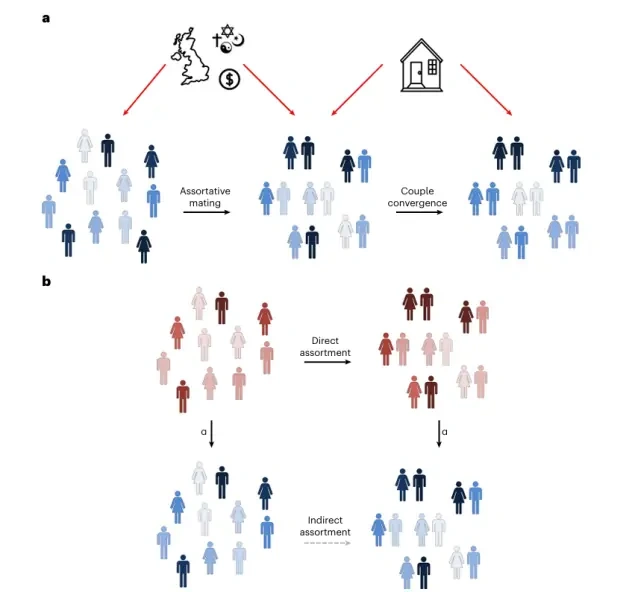
This "birds of a feather" resemblance, then, is half deliberate preference and half the very real way social circles sort us: we mostly meet people who already live in the same frequency band as we do.
The Preference Was Written Into Genes
Having untangled the surface level, researchers dug one layer deeper: is this "preferring similar" tendency itself inherited? Is it a fixed human rule, or does it change with the times?
A 2026 study in Nature Human Behaviour (published in August) answered the question with a new technique — interchromosomal phasing. Without directly genotyping couples, the team reconstructed the parental haplotypes of more than 440,000 people in the UK and Estonia, then compared maternal and paternal genetic similarity to infer the mating preferences of the previous generation.
The analysis locked in 11 traits with significant genetic assortative mating, with height and education the most typical — tall people tend to choose tall partners, and people with similar education levels pair up more easily. Four more traits held in both populations: TV watching time, fluid intelligence, general health, and lung capacity.
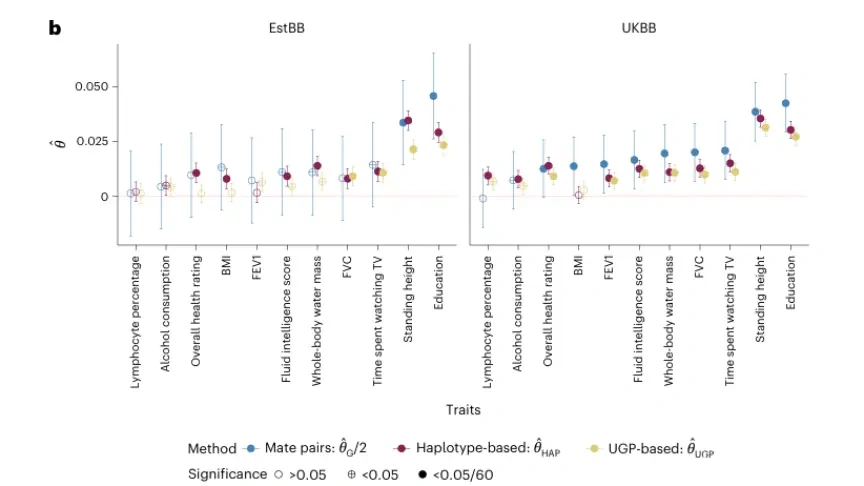
To rule out "they live close, so they're similar," the team ran a control: they randomly paired strangers who lived less than 1 kilometre apart and calculated their genetic similarity. Neighbours did show faint similarity — but real couples were far above that level.
The logic snaps into place: similar circles first place us in front of each other; then the similar traits themselves do the work of attraction.
Younger Generations Want the Same Type More
Here is the strangest part. This "choose similar" pattern has not faded with social openness — it has strengthened in recent generations.
Splitting the sample by birth year into three groups (<1960, 1961–1980, >1980), the study found that assortative mating intensity for the two core traits — height and education — rose in each younger cohort. In Estonia, for example, people born before 1960 had a height mating coefficient of 0.015; among those born after 1980 it nearly tripled to 0.041. Educational similarity rose in parallel.
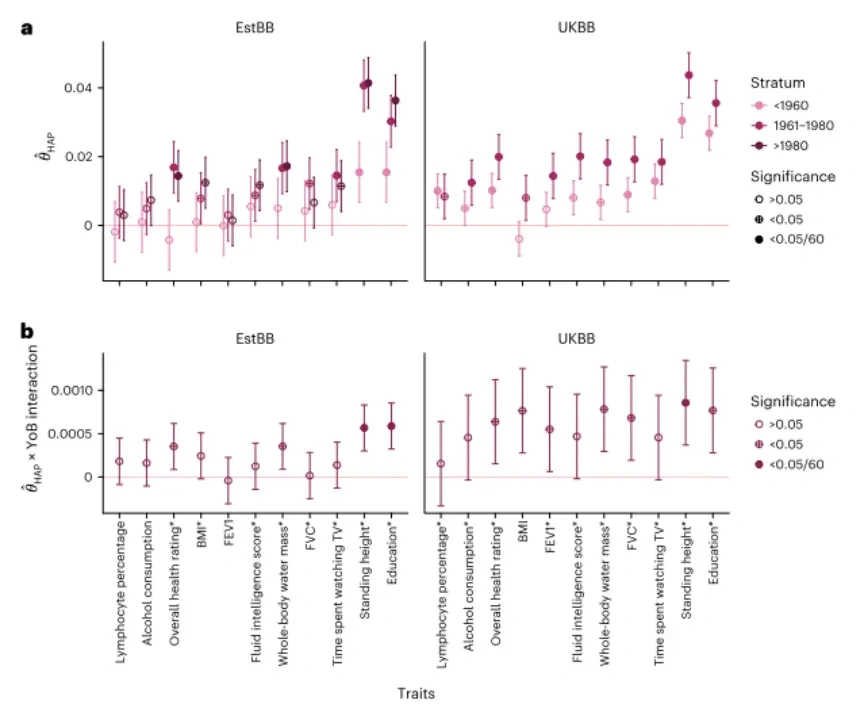
It feels backwards: the older generations were more restricted by geography and family, so they should have "accidentally" matched more similar partners. Today's wider dating pool and freer choice should produce less similarity — yet people pick alike more.
The difference lies in the logic of choice. The old similarity was "no other option": the people around you were simply your neighbourhood and your workplace. The new similarity is "active filtering": with mass education and internet dating, we pre-filter by degree, interest, and lifestyle before asking whether we like someone. Filter hard enough, and whoever is left naturally resonates with you.
The Ideal Partner Is a Better Version of You
Group-level patterns are clear. But person to person: do we really actively prefer someone like ourselves — or is it just an unintended by-product of circle sorting?
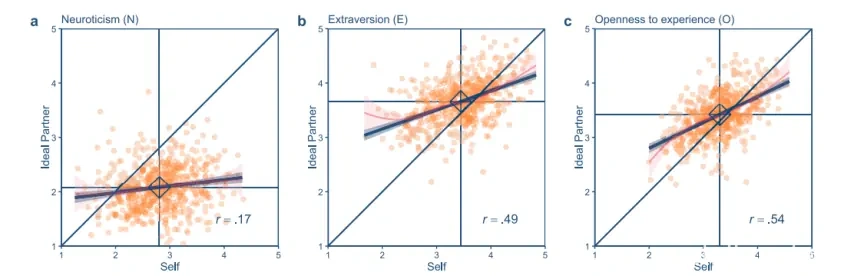
A 2026 study in Evolution and Human Behavior approached this from the angle of the "ideal partner." Researchers asked 538 Norwegian university students to rate their own Big Five personality traits and social dominance orientation (SDO), and to rate their ideal opposite-sex partner on the same scales.