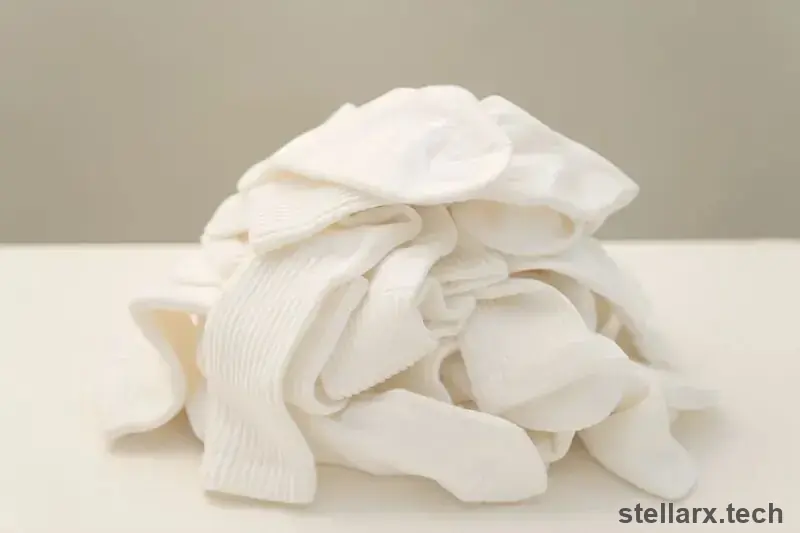
You turn the sock inside out before washing it. Congratulations: that is the one move that makes it dirtier.
It feels like the hygienic choice — expose the side that touched your skin, scrub it directly, let the water get at the sweat and the flakes. A study of one man's socks found the opposite. Flipping them in cold water left the clean side, the side that touches the shoe, carrying more fungus than before.
One pair of socks, measured on both sides
The subject had athlete's foot. He wore his socks eight hours a day, and the researchers pressed each sock against culture plates — the imprint method — sampling the inner face and the outer face separately, then counting what grew.
On the inner face, the side against the sole, the starting load was 189.8 colonies.
Then they washed. Cold water, soapy water, the sock kept right side out, the sock turned inside out. Every one of those washes removed most of the fungus from that side.
Detergent chemistry plus the mechanical work of rubbing, water flow and spinning was enough to reach through the fabric. Nothing exotic was required.
The outer side is where it goes wrong
The outer face told a different story. When the socks were washed in cold water after being turned inside out, the outer face ended up with more fungus than the socks washed right side out.
The numbers: the outer face started at zero colonies. After the inside-out cold wash, it read 2.1.
The authors' explanation is mechanical, not chemical. While the sock is being rolled and turned, the dense fungal load and the contaminated skin flakes concentrated on the inner face are dragged across the fabric and smeared onto the outer face, which had been comparatively clean.
So the flip does not sterilise anything. It redistributes. And it does this specifically in cold water.
What a wash actually removes
If nobody in the house has a fungal infection, the job is ordinary washing plus prevention: cut the routes by which fungus gets carried around, and cut the chances of it settling.
If someone does have athlete's foot or a fungal nail infection, the standard is stricter. Socks get changed daily — the point is to remove the reservoir, sweat and skin flakes, the organic material fungus feeds on. Wash them the same day they come off. The longer a dirty sock sits, the more firmly the fungus establishes itself in the fibres.
| Sock care | No infection in the household | Someone has athlete's foot or nail fungus |
|---|---|---|
| Storing dirty socks | A normal laundry basket is fine | Keep them in a separate bag until wash day |
| Water temperature | Cold or warm, either works | Cold or warm both work, but 60 °C or hotter is better |
| Cleaning agent | Ordinary detergent | Ordinary detergent, or a presoak in 1:10 household bleach or 0.3% QAC |
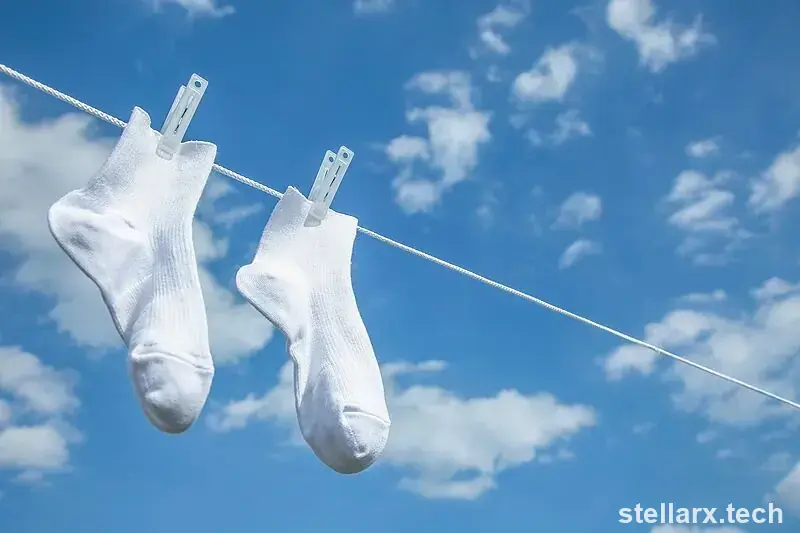
| Drying | Line-dry in the sun | Line-dry in the sun, or tumble-dry |
| QAC = quaternary ammonium compound. The 60 °C line is the same threshold at which Trichophyton rubrum stops surviving a wash. | ||
A few details sit outside that table.
Keep suspect socks separate. Socks you think are contaminated should be stored apart from other laundry, because fungus moves between textiles.
Friction counts. Repeated rubbing, kneading, rinsing and spinning are major removal factors; they are not incidental to the detergent.
Temperature has thresholds. Water at 30°C removes Candida; 60°C kills Trichophyton rubrum, the dermatophyte behind most athlete's foot.
Disinfectants are optional. Bleach or quaternary ammonium compounds (QAC) are not required, but soaking adds an extra margin.
Never dry socks indoors in still air. Line drying in sun, or machine drying, is what actually finishes the job.
The rest of the infected household
Cured skin fungus comes back in 10% to 53% of cases, and personal items are one reason. Spores can survive for months, some for years.
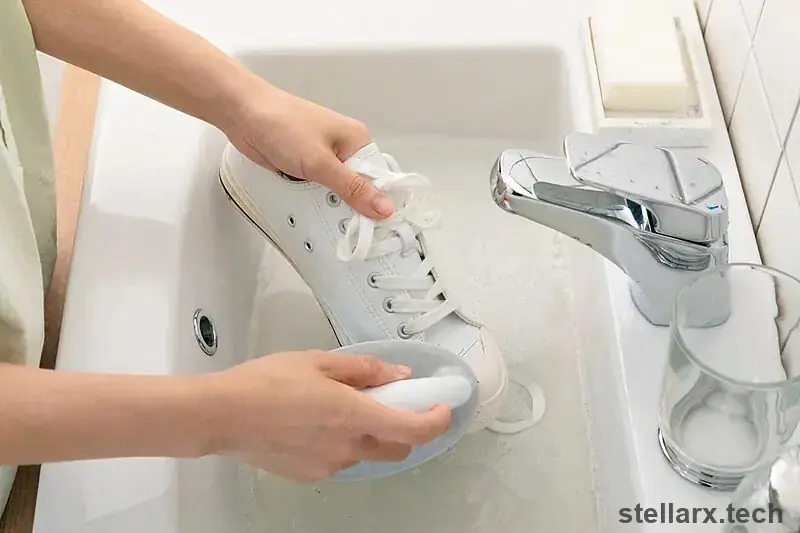
Shoes. This is the item that touches the infected skin most directly, and inside a shoe it is warm, damp and full of flakes. In roughly 40% of patients with athlete's foot or fungal nails, fungus can be cultured from inside the shoes. If a pair can take water — even hot water — wash it, and go as hot as the material allows. If it cannot, ozone or ultraviolet treatment is better than nothing: repeated cycles of UV have cut fungal load by 76% to 85%.
Household textiles. Towels, bedding and outerwear pass fungus along indirectly. Keep the infected person's bedding and towels separate for storage and washing. Surfactants help lift dirt and flakes; repeated rinsing and spinning are the decisive step. Skip the quick-wash cycle, which does too little mechanically. For heat-tolerant blends, a hot steam iron is another physical kill step.