A male mouse, anesthetized at 240 days of age — middle age for a lab animal — had its testes removed. It went on to outlive its intact brothers by nearly a third.
Put crudely, the way the original write-up put it: get the balls snipped, get the years back.
The data is stranger than the slogan. Mice cut before puberty gained less.
Why Women Usually Outlive Men
Across many mammals, females live longer on average than males. Humans follow the same pattern, and smoking, drinking, risk-taking and social circumstances do not fully explain the gap. One long-standing hypothesis pointed at male sex hormones, testosterone above all. Older animal work had shown that removing a male's testes can extend his life. What no one could pin down was when the benefit happens — must the surgery come before puberty, or does changing testicular function in adulthood still move the lifespan needle?
The intuition was tidy: if testosterone does its damage during adolescence, only pre-pubertal castration should pay off big.
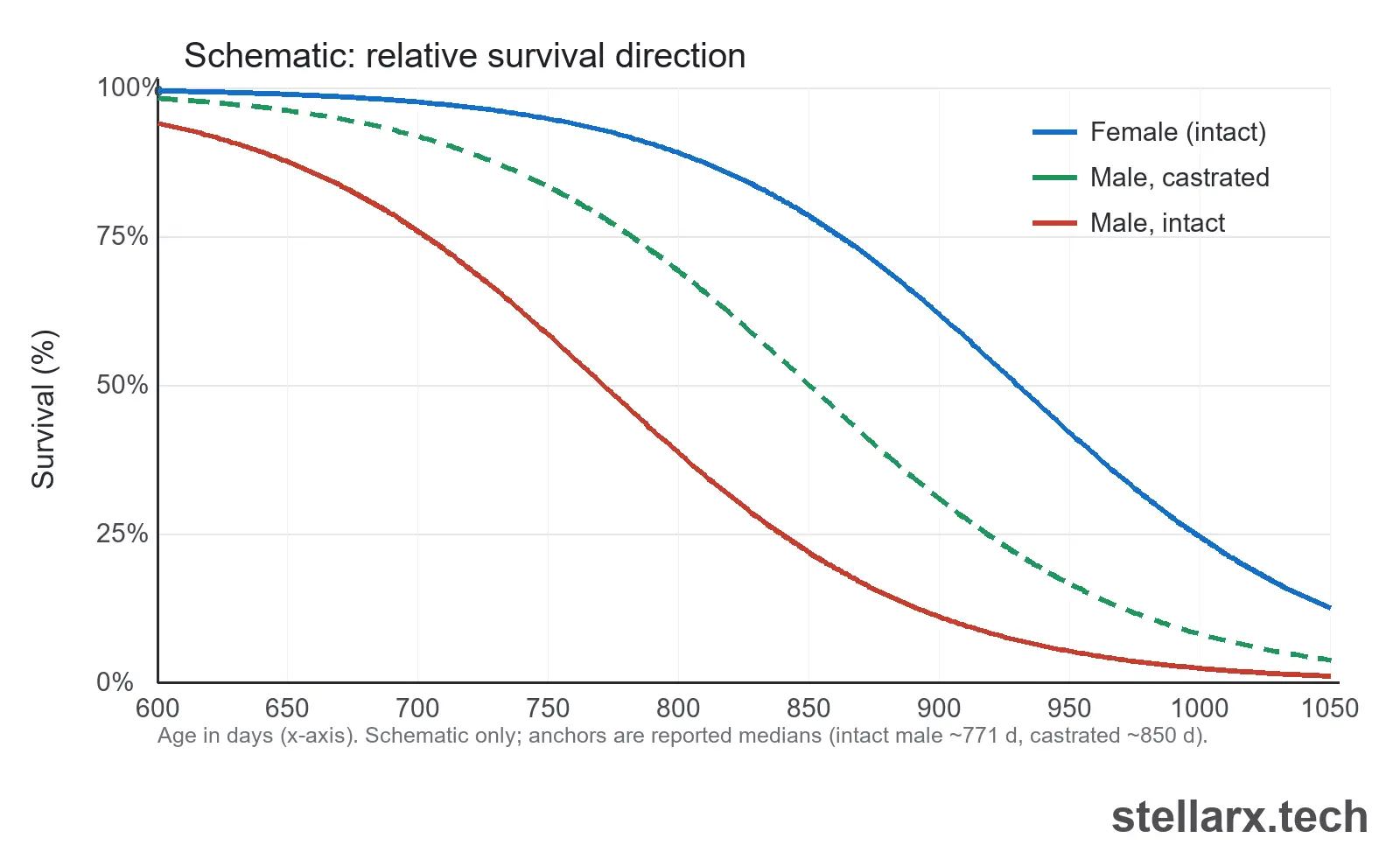
A new study upended that. Researchers at the University of Texas Health Science Center at San Antonio removed the testes of male mice at three different ages, and every group lived longer. The adults, castrated at 240 days, gained the most: median lifespan rose by roughly 33%, or 32.9% in the reported figures.
One caveat sits on top of everything below. The work is a bioRxiv preprint, not yet peer-reviewed, and it says nothing about castrating men.

The Mechanism: Antagonistic Pleiotropy
Male and female mammals differ in more than reproductive organs. Testes make sperm and secrete testosterone, which maintains male reproduction, muscle mass, bone health and secondary sex traits — and, under some conditions, testosterone-linked signaling touches cardiovascular function, immunity, metabolism and disease risk.
Hence a classic idea in aging biology: antagonistic pleiotropy. The same gene or physiological mechanism can help early in life and hurt later. A mechanism that lets a young animal grow fast and win mates may also raise its risk of disease in old age, and evolution keeps it anyway, because early survival and reproduction outweigh late cost.
The study asks whether testicular factors play exactly this double game.
Three Ages, Three Surgeries
The animals were UM-HET3 mice, a genetically heterogeneous line whose males typically die younger than its females — a useful model for the sex gap in lifespan.
Males were split into groups and castrated at 20, 60 or 240 days of age, then compared with sham-operated mice that kept their testes. Twenty days is pre-pubertal; 60 days is post-pubertal; 240 days is adulthood, just before the age when male mortality typically climbs. The team then tracked survival and body composition.

The Result That Broke the Old Assumption
All three castrated groups outlived the controls. The 240-day group led, with a 32.9% gain in median lifespan.
| Age at castration | Developmental stage | Median lifespan gain |
|---|---|---|
| 20 days | Pre-pubertal | about 19% |
| 60 days | Post-pubertal | about 26% |
| 240 days | Adulthood | 32.9% (reported) |
| Gains relative to sham-operated controls, read from the study's summary chart; the 240-day figure is the value stated in the paper. All three groups beat the controls. | ||
The old explanation predicted the opposite: if adolescent hormone exposure had already fixed a male's shorter life, castration after puberty should yield little. It yielded the most. Among the three time points, the adults did best.
Something else stood out. After the 240-day surgery, the males' elevated mortality risk was suppressed quickly — suggesting the relevant testicular factors act in something close to real time, not through an irreversible change laid down early in life.
Useful Early, Harmful Late
Pre-pubertal castration extended life too, just by less. Read together, the two results sketch a hypothesis: before 240 days, the testes may supply some survival advantage; with age, that advantage fades and some harmful influence takes over.
Hormone signals, in other words, can be age-dependent. They support growth, development and reproduction early, and need not favor long survival late.
Which molecule actually does the work is unknown. The researchers have survival curves, not a named factor.
The Body Follows the Hormones
Beyond lifespan, the team watched body composition. Castrated males drifted toward the female pattern: lean mass fell, and fat accumulated steadily later in life. Testicular hormones normally help hold the male-versus-female difference in muscle and fat, so their removal keeps reshaping the adult body.
Whether that shift causes the extra years, or merely travels with them, is unresolved. Leaner or fatter is not the same as healthier.
Lifespan and healthspan are different currencies. One counts years alive; the other asks whether those years still carry working muscle, bone, metabolism and cognition. A treatment that lowers death risk has not thereby proven that it slows aging.
So Is It Just Testosterone?
The obvious guess — less testosterone, longer life — does not follow yet.
The testes are not a testosterone pump and nothing else. Removing them alters other hormones, growth signals, metabolic regulation, body composition and neuroendocrine feedback all at once. Castration is a whole-body intervention, not a switch that turns off one molecule.
To prove testosterone is the lever, someone would need targeted experiments that the survival data cannot supply.
Does It Explain the Sex Gap in Lifespan?
A 2023 study in Aging Cell, by Jiang and colleagues, had already found that pre-pubertal castration lifted the median lifespan of UM-HET3 males from 771 to 850 days and narrowed the distance to females.