The gallbladder was about the size of a peanut, and he swallowed it whole, straight out of a freshly killed snake, because a folk remedy promised it would clear his internal heat and brighten his eyes. Two to three months later, 50-year-old Lao Zhang was doing housework at home when his left arm and leg stopped answering him. He went down, and his body convulsed for roughly half a minute.
He Swallowed It for His Eyes
Lao Zhang is 50 and comes from Taizhou, in Zhejiang Province on China's east coast. According to reports on the case, he had been chasing the effect known in Chinese folk medicine as "clearing the fire and brightening the eyes" — a claim attached to a long list of bitter, cold substances, snake gallbladder among them.
His father bought a wild snake. Lao Zhang did not cook the gallbladder, did not dry it, did not steep it in liquor. He took it out of the snake's body and swallowed it fresh, at what the report describes as roughly the size of a peanut.

First the Left Side Went Quiet
The interval was two to three months. Then, in the middle of ordinary housework, his left arm and left leg lost their function. He fell to the floor and had an involuntary seizure that lasted about half a minute before it stopped.
He was taken to hospital by emergency. The first scans of his head showed something that does not look like a stroke and does not look like a tumour: a brain covered in a large number of speckled lesions, and inside it, a water-filled sac the size of a peanut.
Stroke and tumour were both ruled out. What was left, the doctors suspected, was a parasite.

The Diagnosis Was Neurocysticercosis
Lao Zhang was transferred to the First Affiliated Hospital of Zhejiang University School of Medicine. There, imaging, his history and pathogen testing were put together, and the diagnosis came back as neurocysticercosis — in Chinese, nao nang chong bing, literally "brain cyst worm disease."
The organism named as the culprit was Taenia solium, the pork tapeworm, known in Chinese as lian zhuang dai tao chong, the "chained tapeworm."
What the Worm Does Once It Is Inside
The medical staff quoted in the report explained the route this way: snakes serve as intermediate hosts for a range of parasites, and snakes living in the wild readily carry parasite eggs and larvae. Eating the gallbladder raw, in their account, carries those eggs straight into the human body; the eggs hatch, and the larvae migrate into the brain and form cysts. From there the consequences run from epilepsy to hemiplegia to blindness, and in the worst case they are fatal.
That is the shape of the danger, and it is the shape reported. The detail of how the eggs get in is worth looking at more closely, because it is the part most people get wrong.
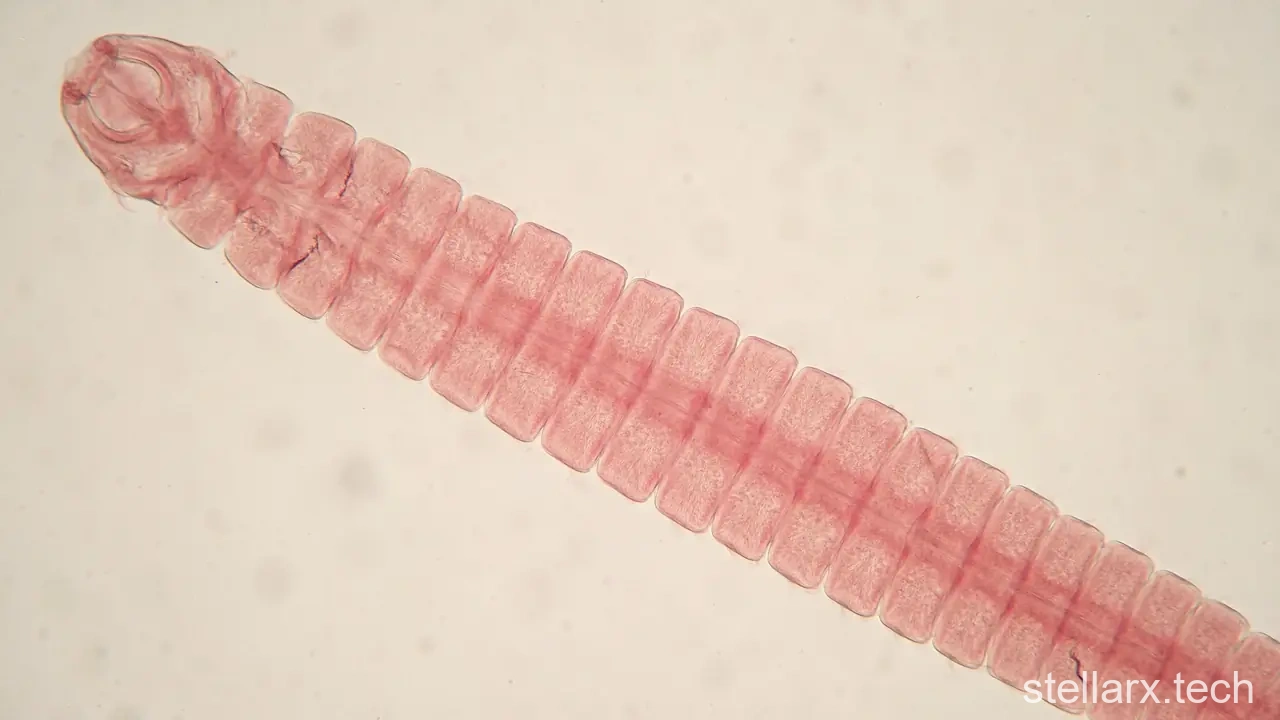
Where Those Eggs Actually Come From
The Centers for Disease Control and Prevention is explicit about the route. Cysticercosis, the CDC writes, is acquired by consuming tapeworm eggs, which hatch in the gut and develop into larvae that penetrate the intestinal wall and travel to muscle, eyes or brain, where the cysts form. The agency's parasite reference page goes further: cysticercosis is acquired "only from the fecal-oral route (ingestion of eggs), not via the ingestion of cysticerci in undercooked pork."
In plain terms, the eggs that end up in a human brain are shed in the feces of a human who is carrying an adult pork tapeworm, and they reach the next person through food, water or hands that the tapeworm carrier contaminated. Undercooked pork containing cysts gives you the adult worm in your intestine — a different condition, taeniasis, with a different set of problems.
So the report's chain, snake to gallbladder to eggs to brain, compresses a step. What it does not do is invent the hazard. Raw snake bile is a documented route for a different parasite, and the literature on it is not thin.
That parasite is the sparganum, the larval stage of tapeworms in the genus Spirometra. A 2020 case report in the journal Medicine describes a woman who had eaten raw snake gallbladders several times, three months before admission, specifically in order to improve her eyesight. She came in with recurrent eosinophilic pleuritis, and the diagnosis was confirmed by a strongly positive reaction to sparganum antigen in both serum and pleural fluid. A separate series of orbital sparganosis cases traced four of five infections to a defined exposure, and one of those was ingesting uncooked snake bile and blood.
The CDC's sparganosis page lists the routes the same way — drinking water that contains infected copepods, or eating the flesh of an undercooked second intermediate or paratenic host — and adds the detail that makes the whole family of raw-animal remedies hard to argue with: a sparganum can live up to 20 years inside its human host.