This one is worth at least five yuan. If you are reading it here, you got it for free.
Why five yuan? Because the claim in the question is nonsense, and proving it took five yuan: the price of the 2026 report as an e-book.
So I bought it. Two hundred and twenty-four pages. I read the whole thing.
The report never mentions a 49.8% employment rate for biology undergraduates. It never mentions a 68% career-change rate. It never ranks biology last in the country.
Here is the part that makes it worse than a rounding error: the report does not publish an employment rate at all. Which means it cannot possibly publish a career-change rate either.
Somebody fabricated the numbers down to one decimal place.
The 49.8% number does not exist
The post making the rounds is dated 1 November 2026 and carries a simple claim: the 2026 employment report found biology undergraduates at a 49.8% employment rate, last in the country, down more than twenty points in five years, worse than civil engineering's slide below 60%. Under 20% working in their own field. A 68% career-change rate.
Every one of those figures is presented as coming from the report.
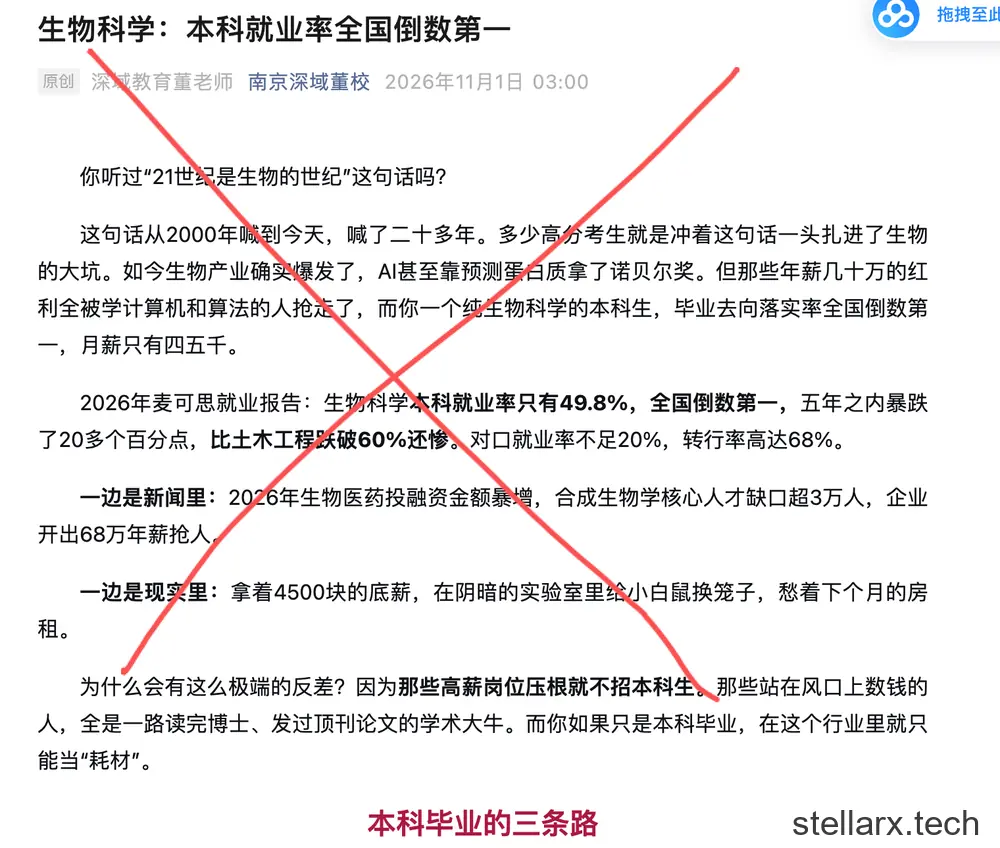
None of it is in the report. Not the percentage, not the ranking, not the five-year drop. The document is 224 pages long and it does not contain the claim that is being attributed to it.
What the report actually measures
The real 2025 figure is a "destination realization rate" of 85.1%. Of that, 57.9% went straight into paid work, and 21.6% continued into graduate study.
Direct employment and destination realization are two different things, and the difference explains most of the confusion in this argument. For 2025 graduates from Double First-Class universities, the share going directly into paid work was only 39.3%, because 48.4% went on to graduate school.
This pattern is especially pronounced in the biological fields. For science majors in the 2025 cohort, the destination realization rate was 86.3% — above the national average. The 2023 and 2024 cohorts came in at 86.0% and 86.6%. Three cohorts, basically flat.
Where biology actually sits on pay
| Major category | 2023 cohort | 2024 cohort | 2025 cohort |
|---|---|---|---|
| Biological sciences | 5,709 (34th) | 5,901 (29th) | 6,100 (32nd) |
| Bioengineering | 5,954 (23rd) | 5,892 (31st) | 6,071 (34th) |
| Biomedical engineering | 6,596 (9th) | 6,869 (6th) | 7,278 (4th) |
| National undergraduate average | 6,050 | 6,199 | 6,435 |
| Average monthly income half a year after graduation, in yuan. Rankings are out of 59, 60 and 61 major categories respectively. | |||
Most of the report is about income, not employment rates. For the 2025 cohort, graduates in the biological sciences category averaged 6,100 yuan a month half a year after graduation. That ranks 32nd among the 61 major categories in the report.
Bioengineering came in at 6,071 yuan, ranked 34th.
Better than some, worse than others. Nowhere near last. Nowhere near "worse than civil engineering".
Look at the three cohorts side by side. Biological sciences moved from 5,709 yuan (34th) to 5,901 (29th) to 6,100 (32nd). Bioengineering moved from 5,954 (23rd) to 5,892 (31st) to 6,071 (34th). Biomedical engineering moved from 6,596 (9th) to 6,869 (6th) to 7,278 (4th). The national undergraduate average moved from 6,050 to 6,199 to 6,435.
From the 2023 cohort to the 2025 cohort, biological sciences pay rose 6.9%, against 6.4% for undergraduates nationally.
And then there is biomedical engineering
There is an outlier in this family, and it is a good one: biomedical engineering. Undergraduates in that category averaged 7,278 yuan half a year out — 4th among the 61 categories.
So does that mean biology undergraduates are actually fine?
No. Look at the five-year tracking.
The real problem is five years out
The report followed the 2020 cohort for five years.
Biological sciences: 5,071 yuan at six months, 9,691 yuan at five years. That is 91% growth, but the ranking is 32nd out of 48 categories.