You know the pair. The laces have not been untied since the day you bought them. The heel counter has collapsed into a lazy fold that fits your foot and nothing else. The insole has taken an imprint of your sole, like a cast.
It is not a good idea to wear the same pair of shoes every day. If you can manage it, rotate two pairs instead. Your feet will feel drier, and your skin will be better off for it.
A hashtag about exactly this — do not wear the same shoes every day — trended this week and split the room. The replies were instantly defensive.
One person wrote that plenty of people wear one pair for years, and that this is fussy nonsense. Another pointed out that the shoes rest at night longer than their owner does. Is that not enough?
Nobody is saying one pair will destroy your feet on contact. But dermatology reviews do suggest rotating shoes every two to three days, and people with foot odor or athlete's foot need it more than anyone.
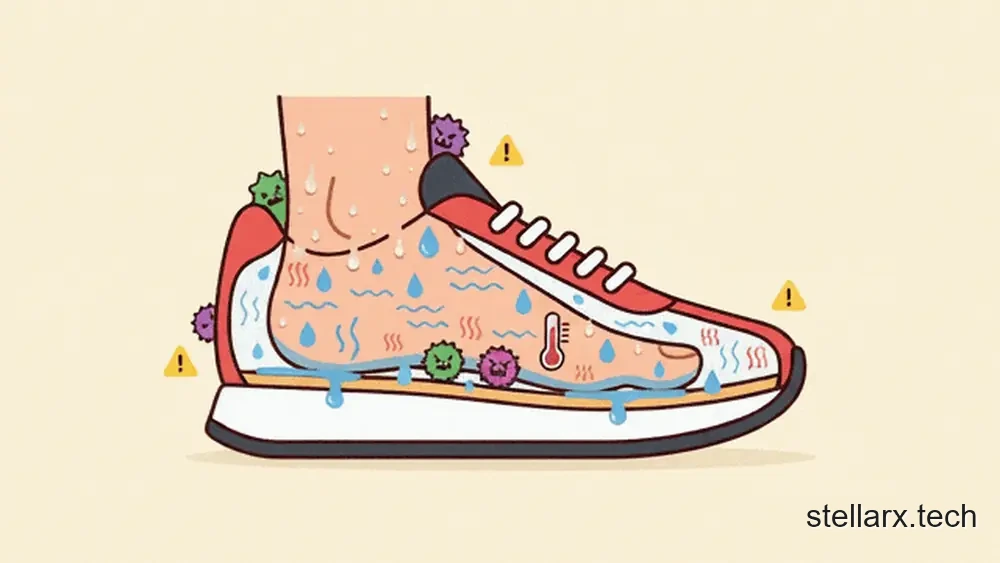
Worn every day, the damp never leaves. The inside stays clammy, and while it stays clammy it is also running a culture. The comfortable pair by the door can walk your feet toward rot, smell and pain.
A Shoe Is a Closed Room With 600 Glands per Square Centimetre
You wash your feet and change your socks. How dirty can a shoe get?
The soles and palms carry the densest population of eccrine sweat glands in the body: about 600 per square centimetre.[1] They run like a humidifier that never switches off. Even sitting still, your feet keep pumping moisture into the shoe, including the sweat you never notice.
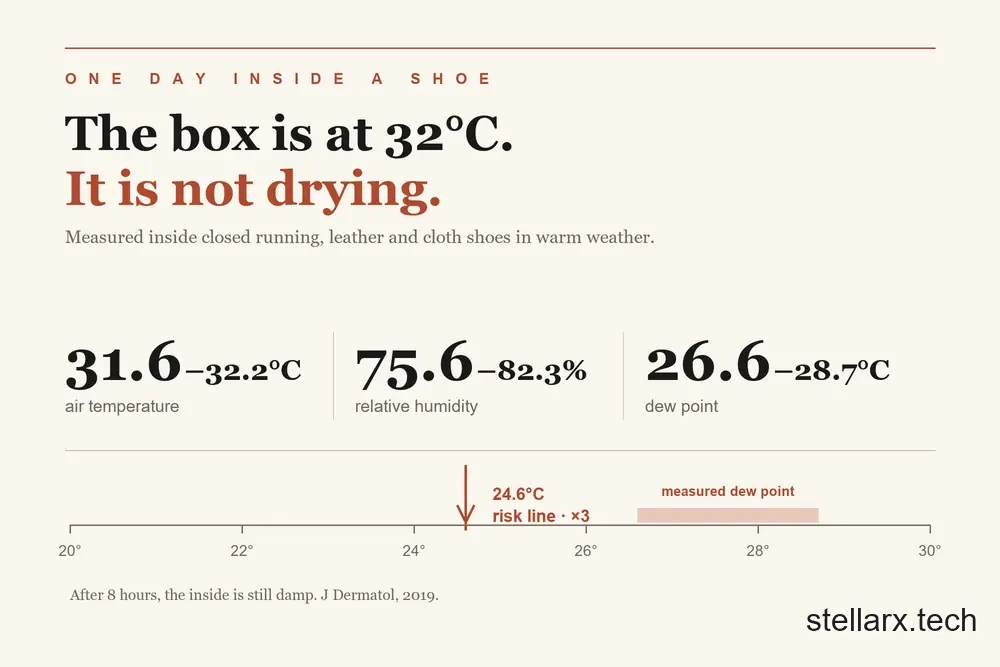
A study measured the inside of the shoe directly. In warm weather, after long wear in a closed running shoe, leather shoe or cloth shoe, the interior climbed to 31.6–32.2°C, humidity reached 75.6–82.3%, and the dew point ran 26.6–28.7°C.[2]
The dew point is the temperature at which water vapour condenses into droplets. The higher it is, the steamier and wetter the air feels.
Sweat soaks the insole during the day. Eight hours overnight is not enough to dry it out. In the morning you slide your foot back into yesterday's damp and add today's sweat on top.
Warm, wet and closed: the exact conditions Trichophyton rubrum, the main cause of athlete's foot, would build for itself if it could.
The Dew-Point Line: 75%, 24.6°C, Three Times the Risk
There is a measurable line. A shoe interior at 75% humidity and a dew point of 24.6°C marks the split. Above it, the odds of athlete's foot run about three times higher. And for every 1°C the dew point rises, the risk climbs another 10%.
Men are hit harder, and the data explains why. Men wear closed shoes more often and sweat more: average in-shoe humidity measured 77.25% for men against 71.96% for women.
Most people who live in permanently damp shoes only notice discomfort — cold, clammy feet. But if Trichophyton rubrum is already established and the skin has a tiny break, the real trouble starts.
The skin between your toes whitens, blisters form, it peels, and it itches badly enough that you want to attack it with a brush. Once water touches it, it hurts.
Congratulations on your new pair of rotting feet.
The Smell Is Chemistry, Not Laziness
Fresh sweat does not smell. Sweat sitting in a damp, airless shoe does.
Bacteria multiply in that warm closed box and break down sweat and dead skin into molecules such as isovaleric acid.[4] The result smells roughly like cheese that has been left out for three days.
If you already have foot odor, Bacillus subtilis settles on the sole and makes the smell worse.[3,4], to the point where even the shoe cabinet cannot contain it.
Hit One: Maceration, Then Gram-Negative Bacteria
Commuting in one pair all day may only mean stuffy feet, a stone under the arch, cold soles, aching after a long walk.
Add heavy sweating, a big sweaty-foot problem, minor skin breaks and long days on your feet, and three health risks climb.
The first is bacterial. Toes soaked in a sweaty shoe absorb water like a dried mushroom in a bowl. The stratum corneum swells, and the barrier fails. Medicine calls this skin maceration.[5]
Once the barrier is gone, Gram-negative bacteria multiply and produce a mixed toe-web infection.[6] It generates a sharp, sweet-rotten smell and turns the space between your toes into white, sodden tissue, with blisters and pustules. Every step feels like the skin is tearing.
Hit Two: Athlete's Foot Becomes Toenail Fungus
Athlete's foot also drags the nails in.
One clinical dataset found that people with tinea pedis carry more than 25 times the relative risk of onychomycosis.[7] Ordinary athlete's foot can usually be controlled with a few weeks of careful cream. Once the fungus reaches the nail, the nail thickens, yellows and crumbles, drugs struggle to penetrate, and treatment runs three months or more, with relapses. Expensive and miserable.
Hit Three: The Midsole Dies at 480 Kilometres
The reason a pair feels good is largely the cushioning and rebound in the midsole. Most running and casual shoes use foamed materials such as EVA.
Worn every day, the air cells in that foam get crushed, collapse and crease faster.
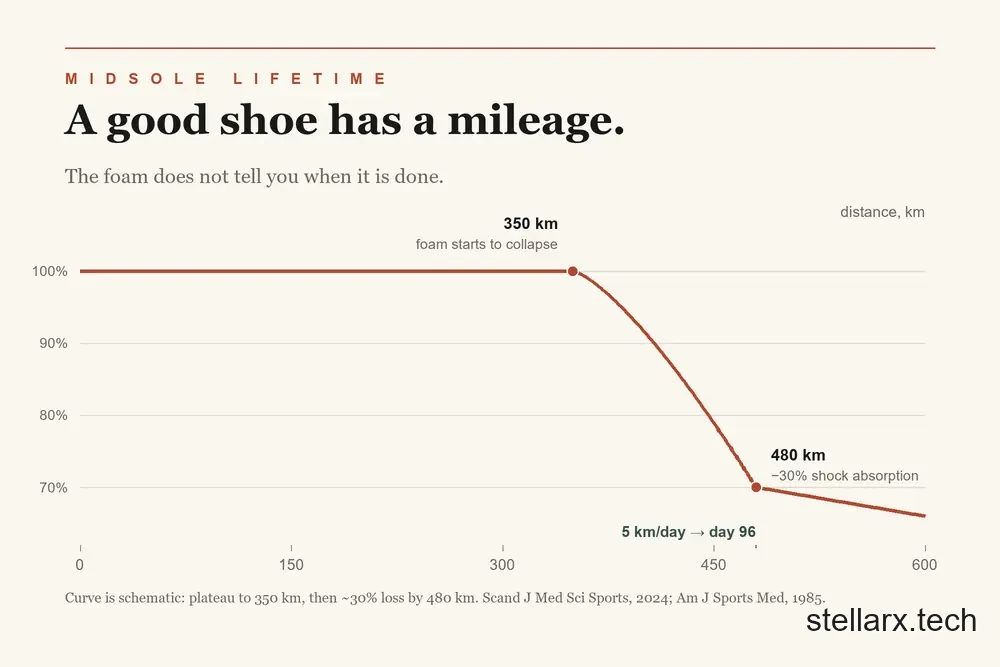
Testing shows an EVA midsole begins to degrade after about 350 km of accumulated wear in real runners.[8] By 480 km, shock absorption has dropped roughly 30%.[9] At 5 km a day, that is 96 days.
When arch support and cushioning fall away, the work does not disappear. Your plantar fascia, calf muscles and knee joint absorb it. The body quietly changes cadence, stride length and ankle angle to compensate, redistributing load through the calf and knee.
Over time this becomes a meaningful risk factor for plantar fasciitis and other lower-limb injuries.[10,11] One study found that workers who made a habit of rotating their shoes cut their plantar fasciitis risk by about 70%.[12]
The 24-Hour Rule and the Other Three Habits
None of this means one pair guarantees damage. It means the foot spends ten hours a day in a closed box, and that box needs to dry.