Say "apex predator" and most people picture a tiger, a lion, a shark — animals that are magnificent, and which the terrifying upright ape now keeps in cages, and which are frightening anyway. This article is not about them. It is about the apex predators of a different dimension.
That dimension is the world of the very small. It has a food chain too, the same game of hunter and hunted, and therefore its own set of creatures standing on top. So when you hear "apex predator of the micro-era," what do you think of?
Some readers will think of a dinoflagellate with an eye. These predatory single cells grew a complete camera eye — retina and lens included — and lock onto prey by sight. They also assemble several trichocysts into one harpoon, and when the eye registers something approaching, the harpoon fires and the prey is gone in a single hit.
But that patent is impossible to copy. Trichocysts are essentially an Alveolata exclusive, and the rest of that cell's wiring is just as proprietary; outside the dinoflagellates, with their freak nuclei, nobody has rebuilt it. So is there a more universal road to power for a single cell?
Of course there is. Become a heliozoan.
The name is accurate. The cell body is usually a sphere, and the "rays" radiating from it are axopodia — axial pseudopodia, or axopods for short. Compared with an ordinary pseudopodium, an axopod has a bundled array of microtubules inside for support, and is usually armed on the outside with extrusomes. Together they make a net that can catch prey from any direction, at any angle, and double as a shield. For a single cell, this body plan is close to perfect everywhere except one thing, and that one thing is movement — which is why various lineages evolved it over and over, independently.
For a heliozoan, movement is not that important anyway. Its prey is mostly plankton, occasionally something small and animal, so it can simply wait for customers. Many species take the next step and grow a thick stalk, anchor themselves to a substrate, and let the current bring the buffet past them.
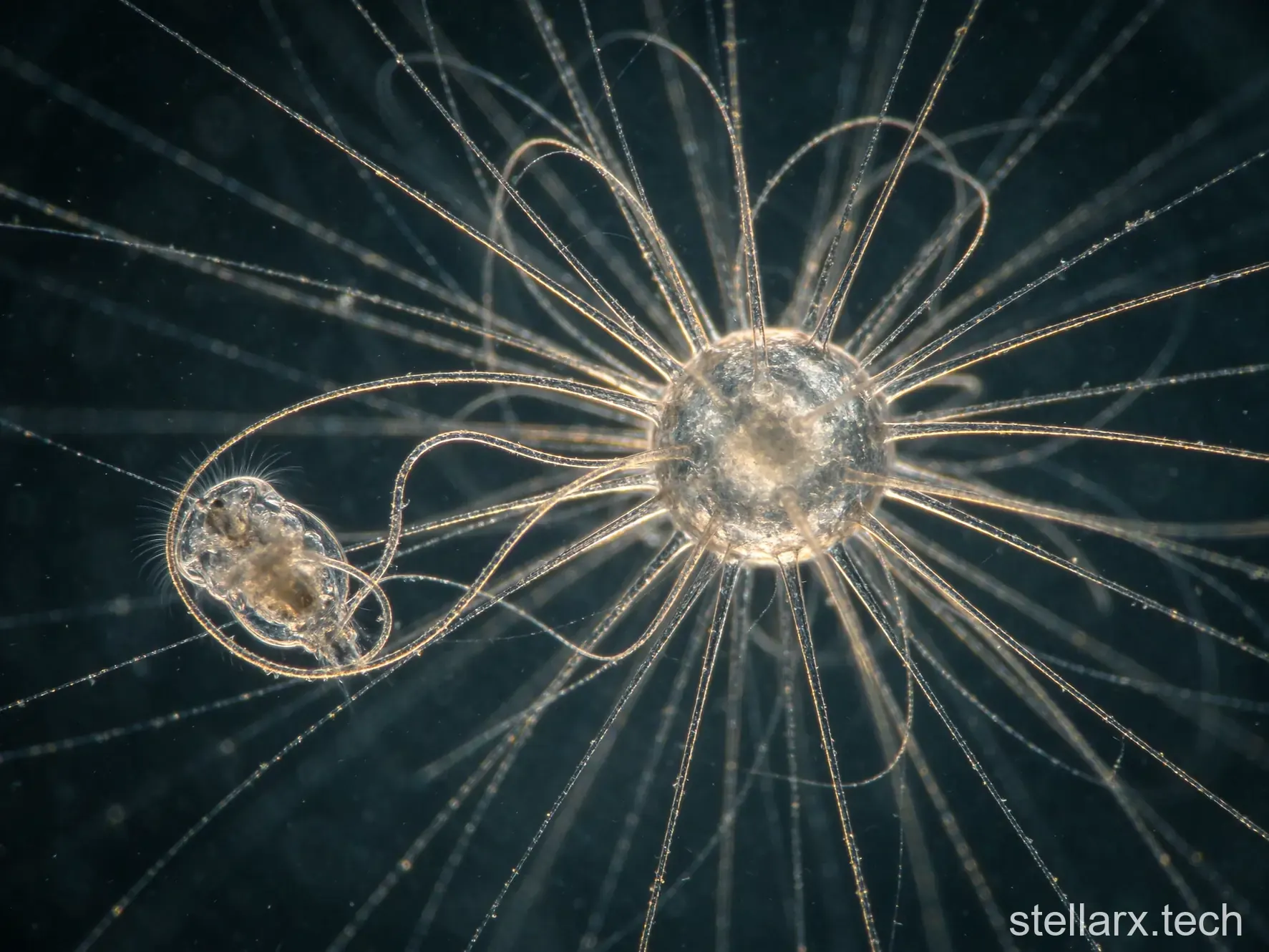
As a group sitting at the top of that food chain, many heliozoans are enormous by single-cell standards, and the body plan is a dirty fighter's build, so the stat sheet is not to be laughed at. One of the largest known, the giant B. magna of the Centroheliozoa, can reach over 6.5 mm across counting the axopodia, and colonies of several individuals can measure several centimeters. For cells normally measured in micrometers, that is a bottomless- appetite monster.
And here is a flag planted for later: as a single cell, B. magna has almost no rivals. As a colony, it is badly outclassed. Take a guess how big the largest heliozoan colony gets before we come back to it.
Even the smaller species routinely punch above their weight and take down small multicellular animals, mostly rotifers and small arthropods; algae and ciliates count as everyday food.
So how did these things work out a power-up path that is specifically single-celled? There seems to be something deeper inside that sun-shaped body.
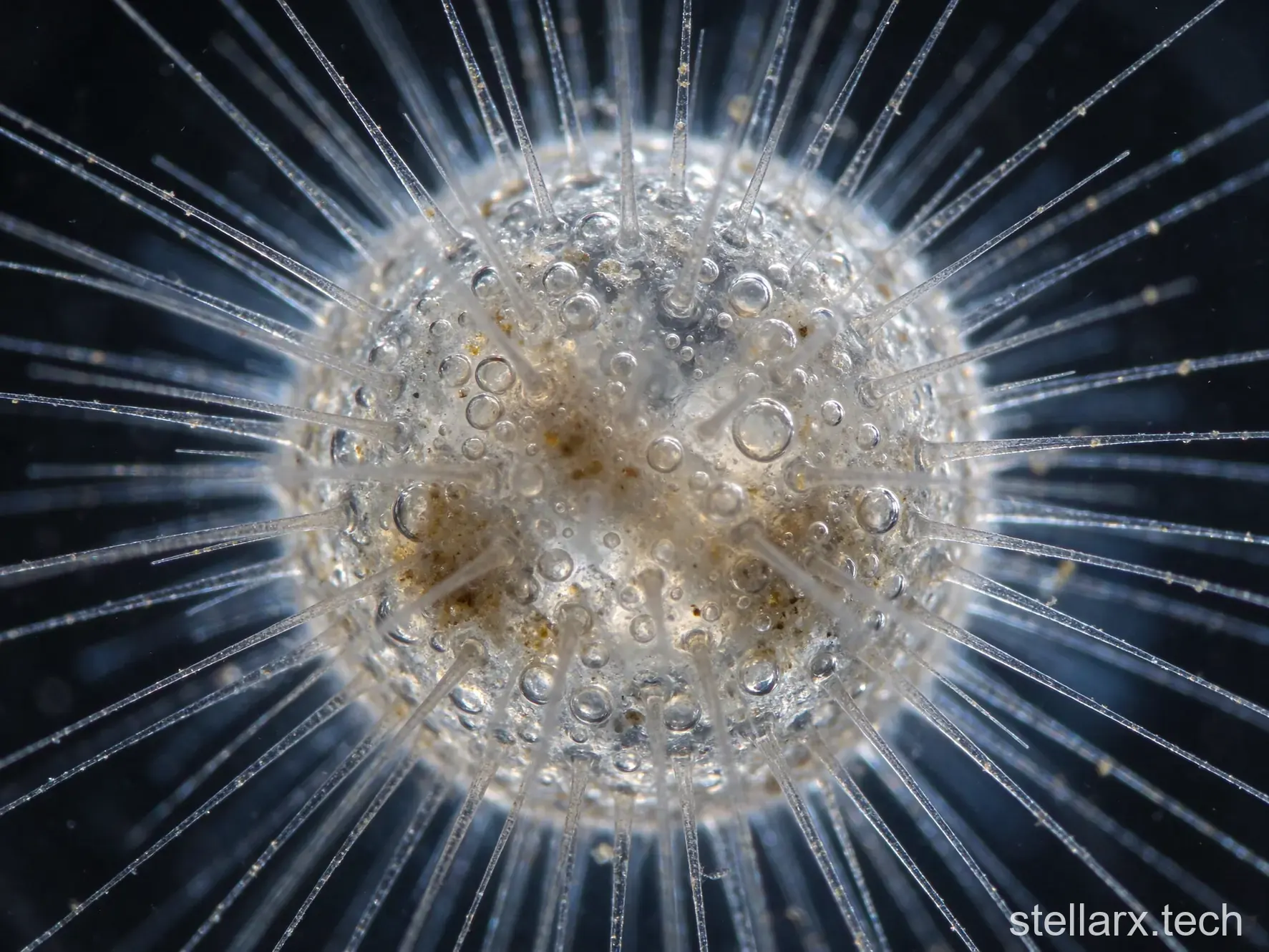
Since the 21st century, molecular work has made one point clear: heliozoans are not a monophyletic group. Lineages with no particular relationship to each other each evolved the sun shape on their own — which makes sense, since it is a fairly universal road to power.
Because it arose many times, the outside of these cells looks alike while the inside is not. The disagreement shows up most sharply at one structural contradiction.
An axopod is a bundle of microtubules stuffed into a pseudopodium, and to keep its shape the bundle needs an intracellular anchor — a microtubule-organizing center, or MTOC. Where should that anchor sit? In the exact middle of the cell. But isn't that where the nucleus is supposed to be? That requirement, Catch-22 in miniature, is the great spatial problem of being a heliozoan.
Life finds a way out. The Centroheliozoa take the simple route: if the nucleus is occupying the center, kick it to the side — a strategy usually called nuclear displacement. They rebuild the center of the cell as a region called the centroplast, and at its core sits a spherical central granule.
Closer in, that granule turns out to have three lobes. The middle one, the central disk, is very flat and extremely dense; the other two are hemispheres of fibrous material. Dense arrays of microtubules — the axonemes — issue from the rim of the centroplast, run through its Golgi layer and endoplasmic reticulum, and continue out to the tips of the axopodia.
Outside the cell body, centrohelids usually carry silica scales and spines for protection, and some species wear a thick mucus coat — Chlamydaster, mentioned earlier, is one — that slows attackers down. Many of them also evolved colonies and cytoplasmic bridges for exchanging material between individuals; the common Raphidiophrys is the textbook case.
Look closely at the axopodia and you will see small dots strung along them like pearls on a wire. These are kinetocysts, a specialized secretory organelle with a fiddly, elaborate structure. When an axopod contacts prey, the kinetocysts inject toxin into it, and the prey stops arguing.
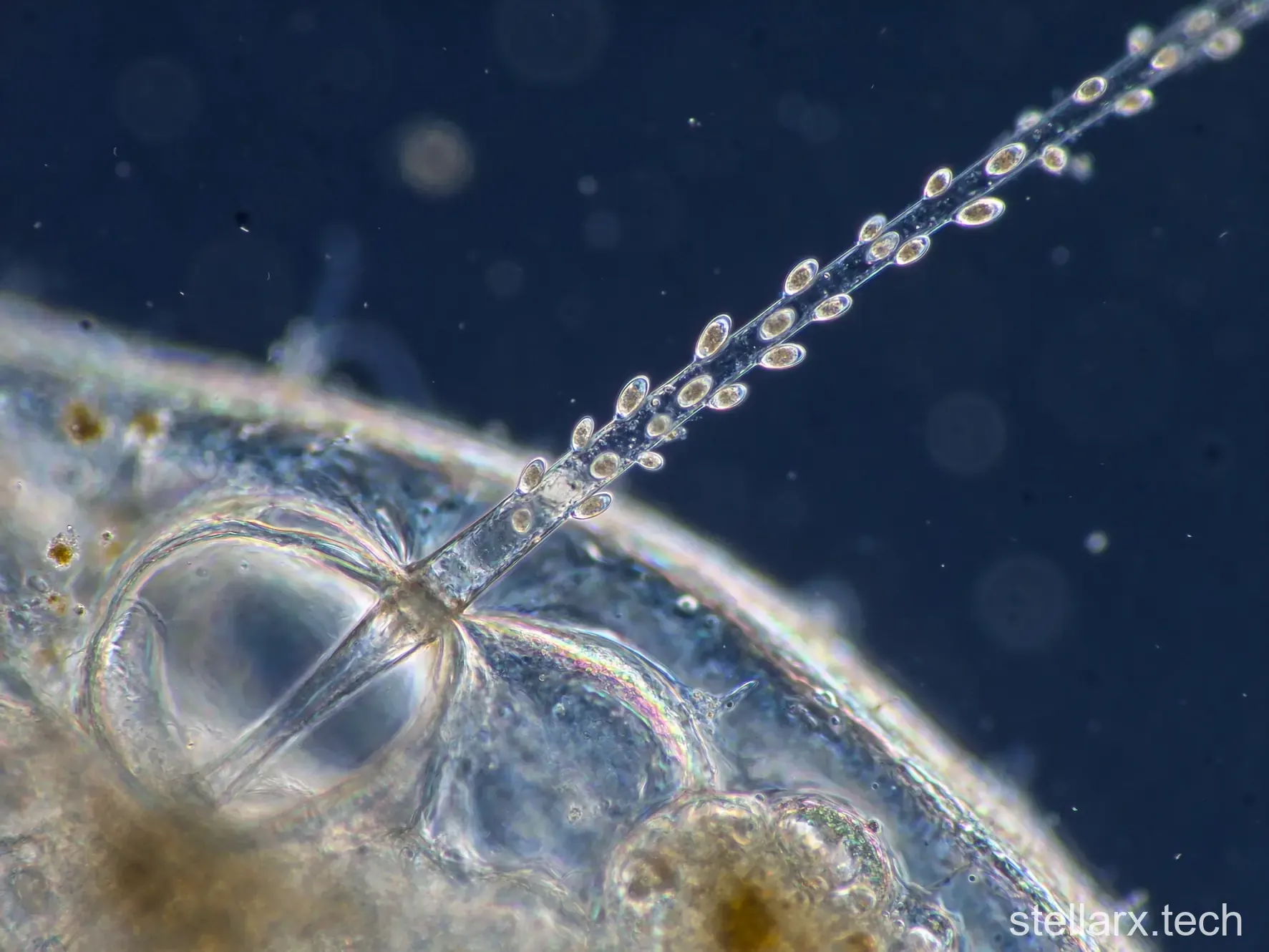
With that kit, the Centroheliozoa are one of the success stories: many species, and a range spanning fresh and marine water worldwide. Next to the Radiolaria, though, they are still rookies. Radiolarians are one of the mainstays of marine plankton, and their diversity is not something a centrohelid can match. Their fossils run from the Cambrian to the present without a break — over 500 million years of being abundant.
Today the Radiolaria are divided into two subphyla and four classes. Compared with other heliozoans, their great feature is a complex but highly regular mineral skeleton; that hard structure is also why they dominate the fossil record, since hard parts preserve. And as members of Rhizaria, they hunt with reticulopodia and filopodia in addition to axopodia — clearly ahead of the field.
The Spumellaria are the well-behaved ones: from outside, basically a sphere with its weapons out. Inside, they are the most compartmentalized protists anyone knows. The cell is divided into layer after layer by the silica skeleton and the central capsule, each with its own structure and function. Algae they capture are partly digested and partly dragged to the tips of pseudopodia to become photosynthetic endosymbionts.
They also have a private answer to the old heliozoan problem. They evolved a structure called an axoplast and shoved it directly inside the nucleus. Axonemes issuing from the axoplast pass straight through the nuclear envelope and out to the axopod tips.
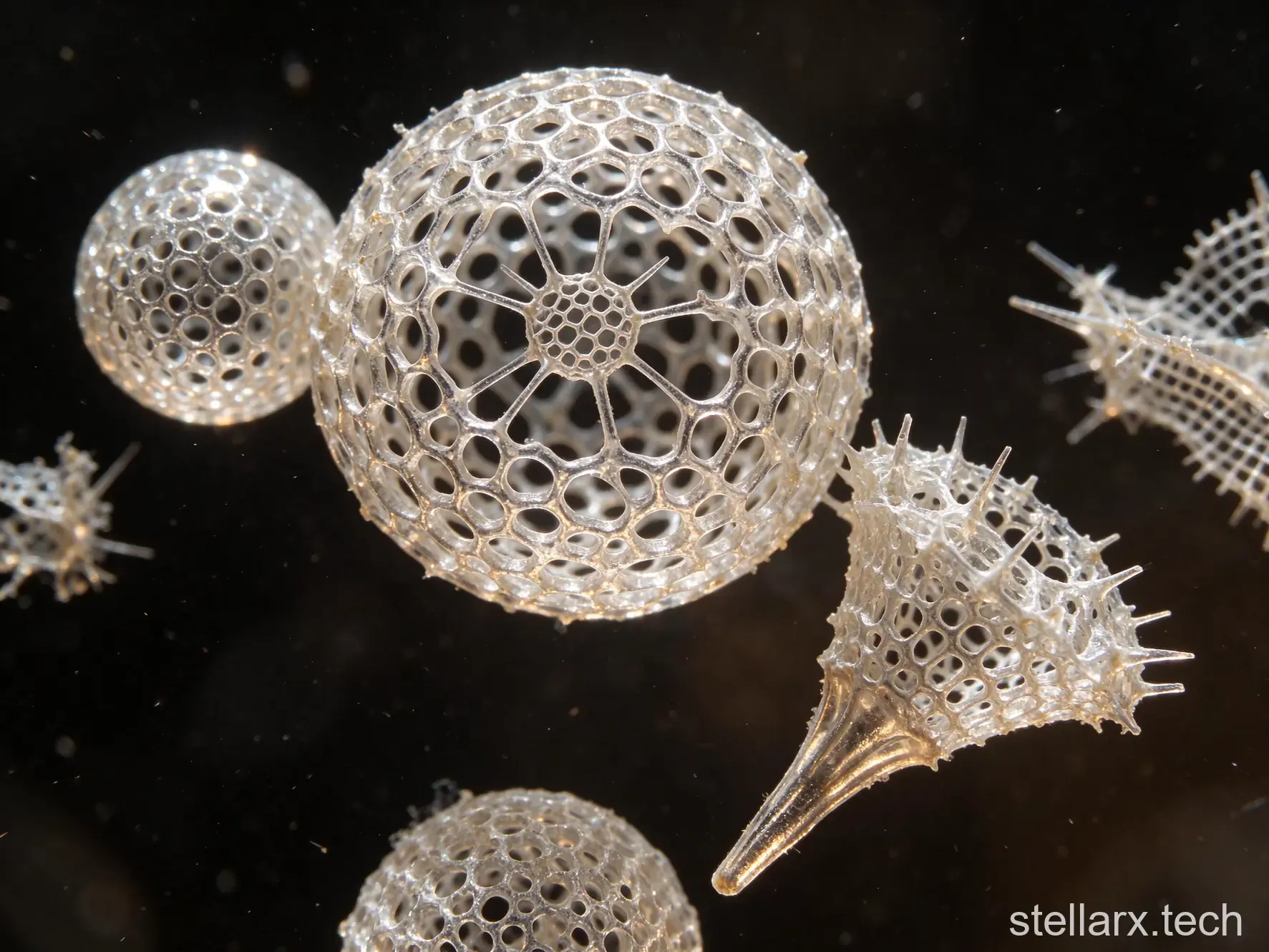
The Nassellaria, close relatives of the spumellarians, are cone-shaped with a big opening at the base, axopodia coming out of it. Their endoplasm is divided into three obvious parts, top to bottom: the cephalic, thoracic and abdominal chambers. At the top of the cephalic chamber there is usually one very stout spine, the apical spine. As members of the Polycystinea their skeletons are perforated like the spumellarians', and the filopodia emerge through those pores.
Since the body is no longer centrally symmetric, the nassellarians do not need to stuff their MTOC into the nucleus the way spumellarians do. They go back to nuclear displacement and move the nucleus off to one side instead.
Some nassellarians ignore all of this. Oroscena, for instance, is huge — over 6mm, unquestionably one of the largest heliozoans — and its main skeleton is spherical, unlike an ordinary nassellarian, with many branching spines that make the surface look densely woolly. It is also thoroughly violent, and bullying small marine animals is no problem for it.
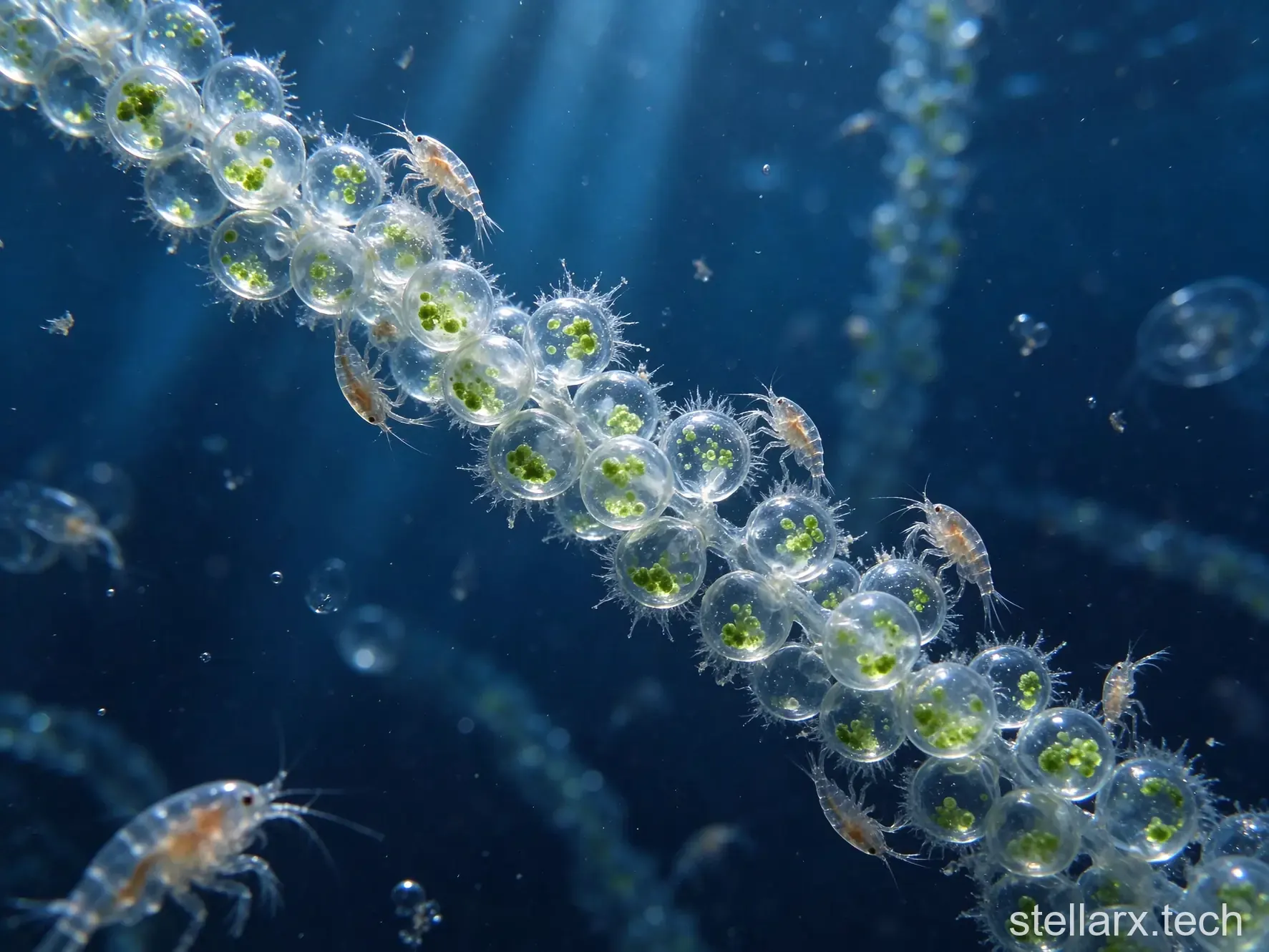
The most reinvented group inside the class is the Collodaria. Their body plan has been remodeled past recognition. The skeleton is internalized and embedded in jelly, and some genera, Collophidium among them, have all but lost that ancestral hard part. Most collodarians are also syncytial colonies: several cells embedded in jelly, and each of those cells is itself a syncytium.
In most colonies the cells stack one on top of another until the whole thing becomes a long strand, which from a distance looks like a furry little worm. Some especially long colonies are said to have been mistaken by uninformed eyewitnesses for dragons — truly a sign of emperors. Young colonies take odder shapes: spheres, doughnuts, even Mickey Mouse.
All collodarians found so far carry photosynthetic endosymbionts, usually a lot of them. That does not mean they have abandoned the ancestral art of hunting with axopodia, but it does make them mixotrophs. In practice, hunting in collodarians is rarely reported, so some of them may genuinely have laid down the knife and become pure photosynthesizers.
Maybe to house more algae, many colonies grow enormous. Time to collect on that flag: the largest known collodarian colony, and therefore the largest known heliozoan colony, belongs to C. longiforme in the Sphaerozoidae, and reaches an astonishing three meters — long enough that it is routinely found parasitized by a copepod, M. efferata.
Not every collodarian is a colony or a syncytium; some are fundamentalists. They are plain spheres, still stuffed with algal symbionts.
Early on, that peculiar morphology led people to file collodarians as a separate radiolarian group. Recent molecular work says they are the sister group of Oroscena, and both sit inside the Nassellaria. The fossil record agrees, since collodarians only appear in the Cenozoic — late arrivals in the radiolarian family. Which makes their origin harder to explain, not easier: anyone can see how different they are from the rest of the Nassellaria, and to this day their evolutionary history is an open mystery.
The other radiolarian subphylum, the Spasmaria, looks so different from the Polycystinea that people long argued it did not belong in the Radiolaria at all; molecular work has since rejected that. The Acantharia are the best studied of them, and their signature is a skeleton of celestite — strontium sulfate, SrSO4 — instead of silica. That mineral is so scarce in seawater that an acantharian's skeleton dissolves after death, which is why they hardly fossilize, and why their history stays fogged.
Their shapes are usually very regular — near-spherical, a few elongate — with axopodia and spines arranged symmetrically, which probably makes them the best-looking radiolarians.
Inside, they usually have several nuclei, and some have photosynthetic symbionts. Each axopod tip carries its own MTOC, attached to a celestite spicule; outside the cell there are elastic ligaments and myonemes for pulling, and reticulopodia usually extend from the tips.
Close to the Acantharia sits the Sticholonchea, the most unhinged radiolarians of all. The class has one known species, plus a pile of unnamed lineages recovered from environmental DNA, living in deeper water. At a glance, the mess of spines outside the cell, with scales and axopodia faintly visible, makes it look frankly unnameable.
Look closer and there is a kidney-shaped object camped in the middle of the cell, taking up much of its volume. Closer still, and its surface is studded with neat rows of small dots with a pearly sheen. That object is the nucleus.
Even across all eukaryotes, a nucleus shaped like that is startling. The dots on its surface are stranger: they are the MTOCs, and the long axonemes issue from them and run out to the axopod tips. So its answer to the old heliozoan problem is to tile the entire surface of the nucleus with microtubule-organizing centers.
Its axonemes are somehow sorted into groups. On the dorsal side — the concave side of the kidney — six of them converge into two columns that support the two stoutest, rigid, prey-catching axopodia at the front of the cell. On the convex side the axonemes do not converge; each supports one flexible axopod at the back. These apparently paradoxical flexible arms are pulled by myonemes at particular positions and swing in three groups, giving the cell forward thrust — which makes S. zanclea one of the very few heliozoans that can move under its own power.
S. zanclea has no mineral skeleton at all, so its spines and scales are purely extracellular. The spines are not random either: each cluster starts from one point on the scale layer. All of these hard parts are silica, compositionally unlike its acantharian relatives. Early biologists, faced with something this deranged, essentially could not place it taxonomically. Molecular biology has since shown it is just an unusual radiolarian.
Compare that with the Phaeodaria, which were recently elbowed out of the Radiolaria altogether. Their signature is a structure called the phaeodium, occupying much of the cell and extremely conspicuous in transmitted light. It is usually described as a storeroom for undigested food and waste awaiting disposal, though there is also evidence it matters more than that, because daughter cells inherit their mother's phaeodium.
Like radiolarians, phaeodarians have a central capsule and a mineral skeleton — silica again — and that combination charmed a whole generation of taxonomists. Their central capsule has three pores: two smaller lateral pores with MTOCs embedded in them, whose axonemes bend along the capsule wall before shooting out to the axopod tips — yes, they solved the old problem by bending the axonemes. The single large pore, the astropyle, is where the capsule connects to the phaeodium.
Unlike radiolarians, their skeletons are fragile, so although they are widespread in the world ocean their fossil record is miserable next to the real radiolarians. The skeleton also has a big opening at the bottom, the mouth, with several axopodia emerging — the main channel for feeding and for waste.
Since the 2000s, molecular work has settled that phaeodarians belong to the Thecofilosea, inside the Filosa, and are at best distant relatives of the Radiolaria. The two groups took completely different evolutionary routes; the similarities are convergence playing tricks on us.
Morphologically, other thecofiloseans wear an organic shell outside the cell, and ultrastructural work produced a result that makes your eyes swim: in phaeodarians, that shell is the wall of the central capsule. Which suggests the ancestral phaeodarian was basically a bare central capsule, and everything outside it — the phaeodium, the mineral skeleton — came later. Their molting behavior supports this: sometimes they abandon the old skeleton, the capsule and phaeodium walk out, and a new skeleton gets built.
As deep-sea plankton, phaeodarians drift and wait like almost every other heliozoan. Most are loners, but some, Tuscaretta among them, build very distinctive colonies: several cells gather and weave a silica sphere around themselves, each cell pinning itself to the ball with four specialized long spines. The result looks like a wild sea mine.
Tuscaretta is the largest phaeodarian: single cells around 6mm, colonies over 10cm across and visible to the naked eye. Each cell is clearly bilaterally symmetric with two mouths, two central capsules and two nuclei — so they are syncytia. Their colonies are syncytial too, but since the cells do not touch, they are quite different from a collodarian colony. The silica ball probably works like a spiderweb, or a cage, intercepting and holding passing prey.