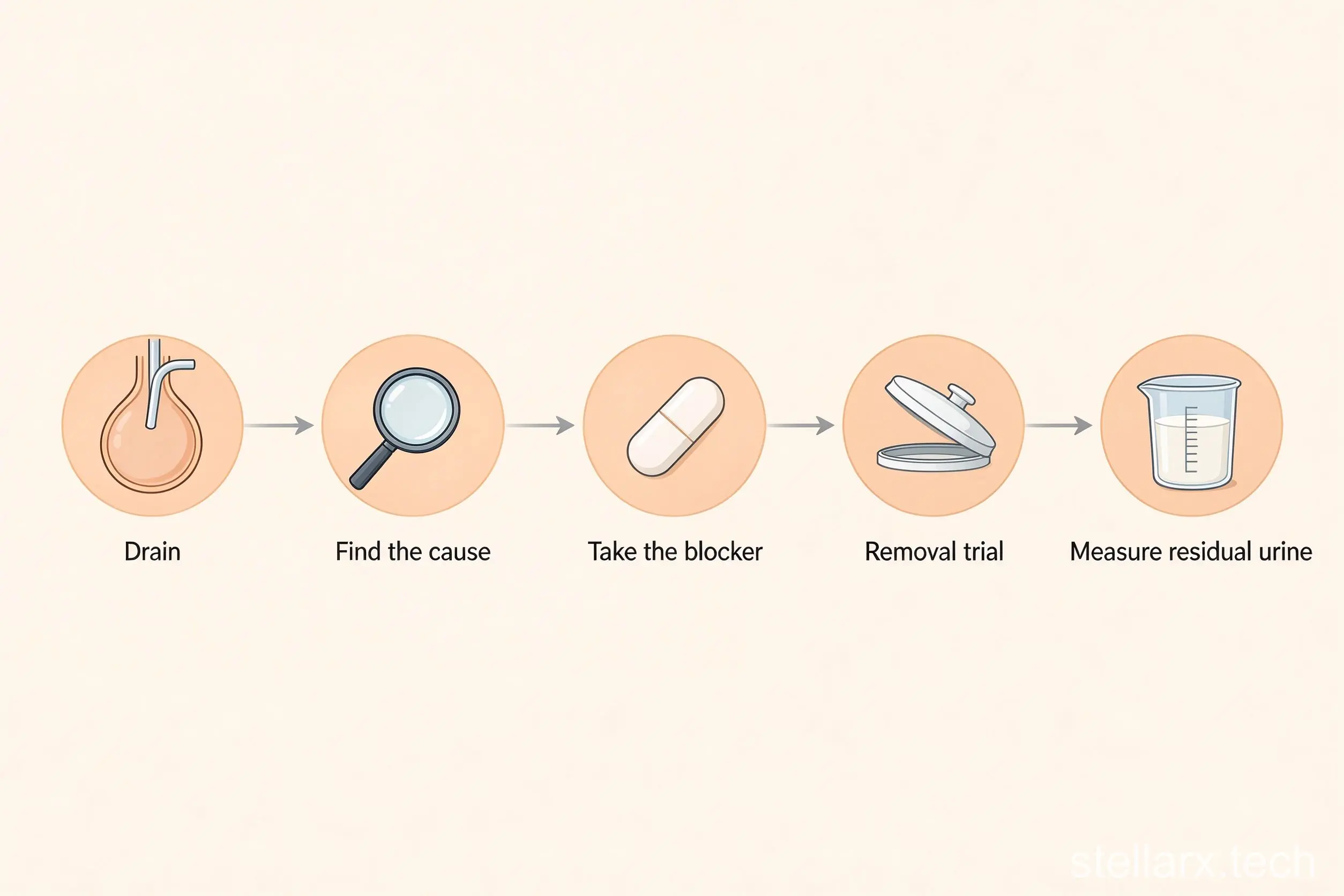
When a urinary catheter goes in and urine flows out freely, it only proves that the outlet can be pried open — not that the bladder still has the power to push urine out on its own. Catheter drainage treats the symptom, not the disease: it wedges open the exit, it does not repair the bladder.
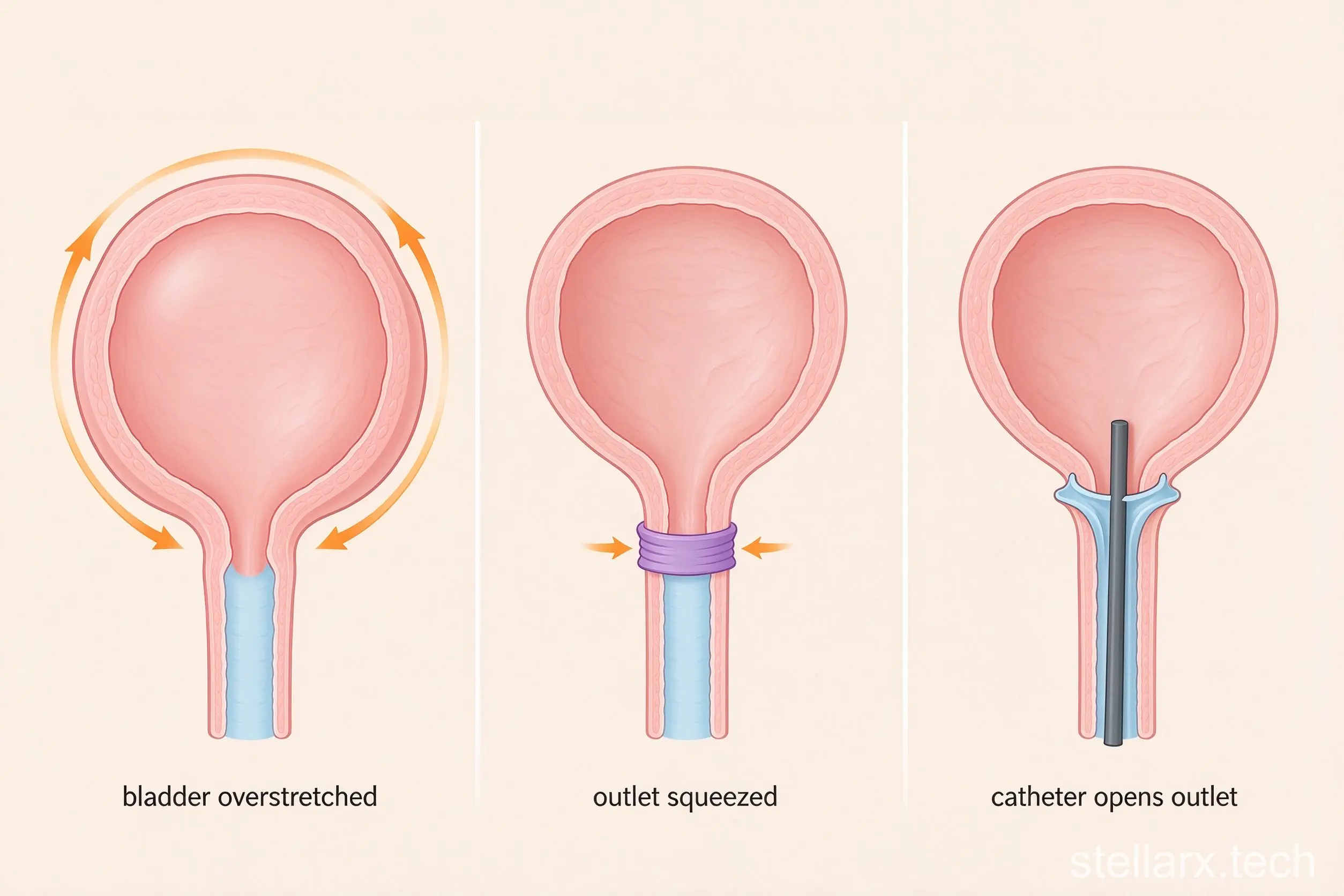
Acute urinary retention occurs in men with prostate enlargement at a rate of about 6.8 episodes per 1,000 men per year. The trial of voiding after catheter removal has hovered around a 50% success rate for decades. The reason: one episode of severe retention crushes both ends at once. Smooth muscle around the prostate and bladder neck squeezes the outlet shut, while the bladder wall muscle, overstretched, is temporarily unable to push.
Drugs can loosen the first end. The second end can only wait for itself to recover.
Why the Tube Always Wins
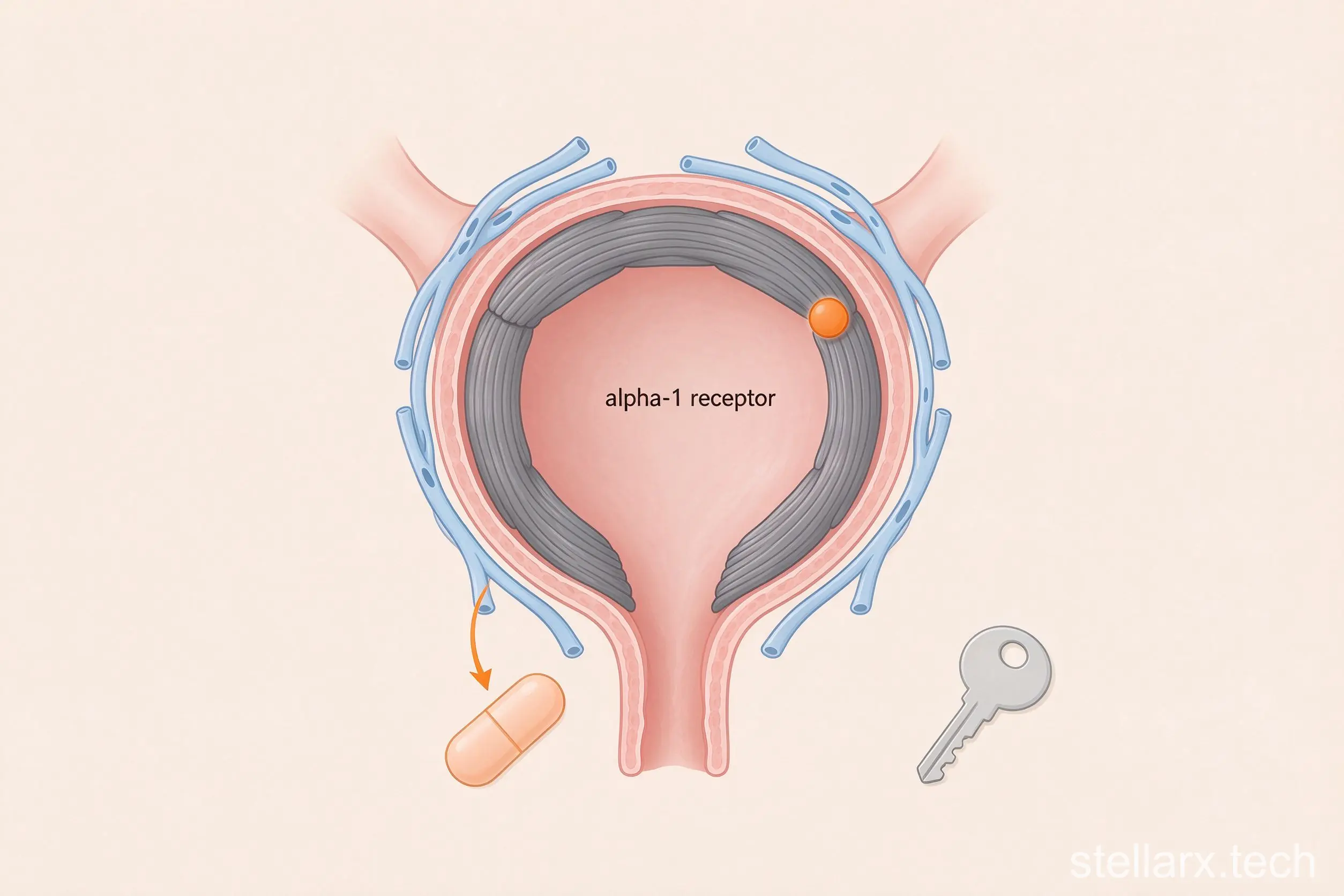
The male urinary outlet has two gates: the bladder neck, and the segment of urethra wrapped by the prostate. The smooth-muscle tension of both is controlled by alpha-1 adrenergic receptors. When the smooth muscle tightens, the urethral lumen narrows, and the bladder must generate higher pressure to force urine through.
In an enlarged prostate, outlet resistance has two parts. One is structural: the gland physically flattens the urethra, and this part does not change with emotion or drugs — the "static" component. The other is dynamic: tension generated by smooth muscle, which responds to nerves and drugs. Decongestant cold medicines containing pseudoephedrine, stress, getting cold, alcohol, and prolonged urine-holding can all temporarily raise the dynamic component. Many men have their first acute retention without obvious worsening in the previous months, simply because a temporary factor pushed the dynamic resistance over the edge.
A catheter is a tube with enough stiffness. Inserted, it physically wedges both gates open. So urine comes out. But that is a different question from whether the bladder can push on its own — the catheter needs no help from the bladder muscle.
The Pump Loses Power
The main body of the bladder wall is the detrusor muscle. Its contractile power depends on two things: intact connections between muscle cells, and blood inside the wall.
The bladder wall has a peculiar blood supply: during filling, wall pressure rises and the vessels are flattened, so the wall mainly gets its blood back during the window after voiding, when the pressure is released and the bladder collapses. In acute retention, the bladder is stretched to 700, 1,000 mL or more; wall pressure stays high for a long time, small vessels are squeezed, and the detrusor sits in ischemia. Catheter drainage removes the pressure and blood flow returns — which brings reperfusion injury. Repeated cycles of ischemia and reperfusion produce ongoing oxidative stress, and research views this as a major pathway to detrusor underactivity: the muscle can still contract, but strength and coordination drop a gear.
So after removal, failure to void is often not because the outlet is more blocked than before, but because the power of the bladder pump has been downgraded. Recovery takes weeks, not hours — and drugs help it little.
A clinical pattern follows: the more urine drained, the more likely removal fails. In the ALFAUR study, a drained volume of 1,000 mL or more made successful removal significantly less likely (odds ratio 0.361, 95% CI 0.225–0.571); age over 65 was an independent adverse factor (OR 0.309). The harder the stretch and the older the muscle, the slower the recovery — mechanically intuitive.
What an Alpha-1 Blocker Can Actually Do
Since the drug can only loosen the outlet side, its ceiling is real.
ALFAUR randomized 360 men with first acute retention from prostate enlargement to alfuzosin 10 mg once daily or placebo, with removal after three days. The proportion voiding spontaneously within 24 hours: 61.9% versus 47.9% (P = 0.012).
The 2019 European Association of Urology systematic review pooled several trials with more stable estimates: alfuzosin 322/540 (60%) versus placebo 156/400 (39%), OR 2.28 (95% CI 1.55–3.36); tamsulosin 75/158 (47%) versus 40/139 (29%), OR 2.40 (95% CI 1.29–4.45). Direct comparison of the two drugs found no winner (59% versus 54%, OR 1.28, 95% CI 0.68–2.41).
| Intervention | Spontaneous voiding rate |
|---|---|
| Placebo (pooled, 3 trials) | 29% |
| Tamsulosin | 47% |
| Placebo (pooled, 7 trials) | 39% |
| Alfuzosin 10 mg | 60% |
| Data: Karavitakis M, et al. Eur Urol 2019 (pooled 10 randomized trials, n = 1,237). Even without drugs, about four in ten men recover spontaneous voiding. | |
A new meta-analysis published in September 2026, pooling 8 randomized trials, gives a combined risk difference of 24.5% (95% CI 18.4–30.7).
Two points follow. First, about four in ten men recover spontaneously without any drug — the bladder has real self-repair capacity. Second, about four in ten still fail even with the drug — for those men the obstacle is not smooth-muscle tension. This matches the two-end mechanism: the drug manages one end only.
The benefit of alpha-1 blockers is not limited to removal day. In the second phase of ALFAUR, men who succeeded at removal were randomized again to continue the drug for six months. The need for prostate surgery: 17.1% versus 24.1%; the time distribution differed more — 65% of operations in the placebo group happened within the first month, versus 36% in the drug group. In both groups, the main reason for surgery was recurrent retention (about 80%). In other words, successful removal only postpones the emergency operation; the drug stretches out the buffer period.
Who Still Needs Surgery
Removal success is not problem solved. A Turkish single-center review followed 425 men with first acute retention, all managed with drainage, alpha-1 blocker and a removal trial: 228 eventually had surgery, 197 were maintained on medication. On multivariate analysis, the independent variables were prostate volume, retained volume, blood urea and the International Prostate Symptom Score (IPSS) — with symptom score the strongest discriminator of the set (area under the curve 0.941).
This is a single-center retrospective study with a high surgery rate; it cannot be transplanted directly to other populations. Men who reach a urology emergency department and get admitted