Rain that falls on the western Amazon has, in a measurable fraction, been inside a tree. Not near a tree, not under one — inside it, pulled up through the xylem from soil several metres down, evaporated out of the stomata of a leaf, carried west for a thousand kilometres, condensed, and dropped. Isotope ratios in the rain can tell you roughly how much of a given storm's water has been through that cycle, and in the western basin the answer is a large fraction.
The name is unfortunate. "Flying rivers" sounds like a metaphor for something mystical, and it is nothing of the kind. It describes persistent corridors of atmospheric moisture, tens of kilometres deep in the boundary layer, moving west across a continent and being repeatedly recharged from below by the forest they pass over. The forest is not passive terrain under a weather system. It is a component of the system.
The accounting
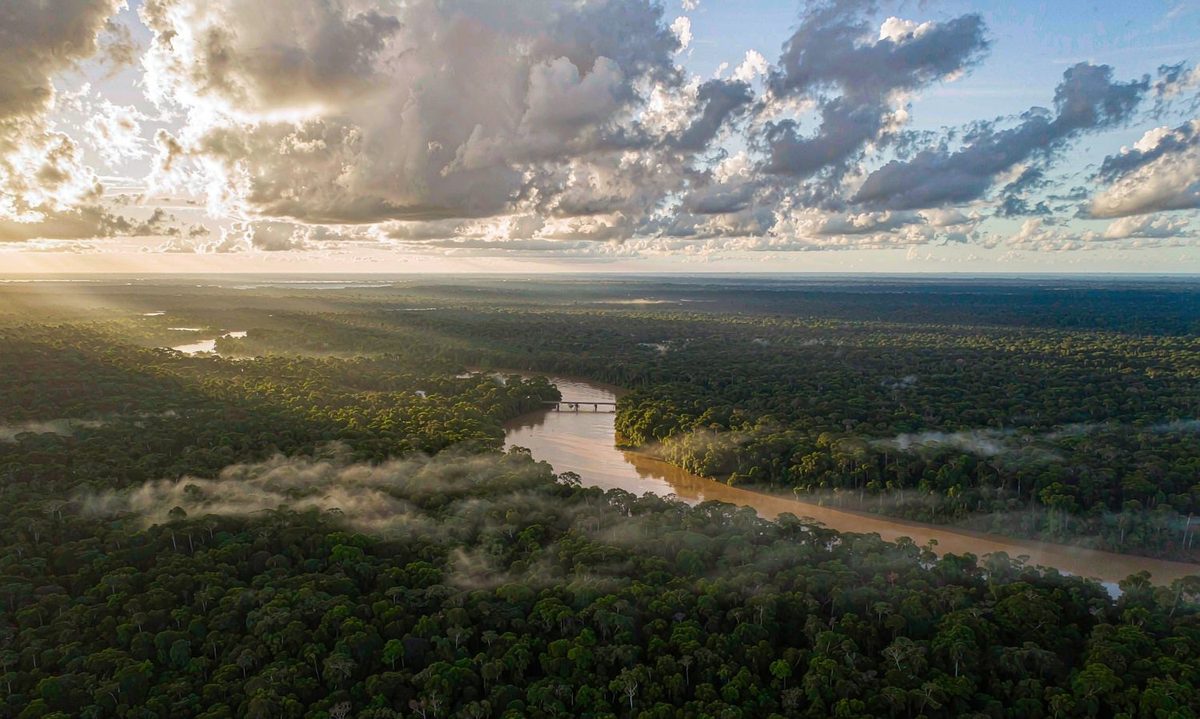
Most of the water vapour over the Amazon enters from the tropical Atlantic, carried by the trade winds. As that air crosses the lowland basin it rains, and the rain would deplete the moisture supply within a few hundred kilometres if nothing replaced it. The replacement is evapotranspiration: evaporation from wet surfaces plus transpiration from leaves.
The numbers from the isotope and atmospheric-transport literature are worth carrying around, with the usual caveat that different methods give different values.
Roughly a fifth of the rain that falls on the Amazon has been transpired by Amazon trees. That figure is not a simple single pass; about half of the recycled water comes from one precipitation-and-re-evaporation event, and the other half from chains in which water is rained out, re-evaporated and rained out again, up to five or six times as air moves from the eastern basin toward the Andes. By the time the flow reaches the mountain wall, up to sixty per cent of the moisture in it has a terrestrial origin. Further south, over the La Plata basin, the recycled fraction can approach nearly all of it.
The flux is large in absolute terms: one mature tree can move several hundred litres into the air on a hot day, and the basin-wide total is on the order of the Amazon River's discharge.
How a tree lifts water a hundred metres
Transpiration is not pumping in the way a heart pumps. It is evaporation, and it happens because air is drier than the inside of a leaf.
Inside the leaf, the air spaces are close to saturated. Outside, the vapour pressure deficit — the difference between how much water the air could hold and how much it does hold — is often large. Water evaporates from the wet cell walls lining the air spaces into the leaf's internal atmosphere, and from there it diffuses out through the stomata.
Each stoma is flanked by two guard cells that change shape as they take up or lose potassium and water. Well supplied, they are turgid and the pore is open; drought-stressed, abscisic acid triggers ion release, they go flaccid, and the pore closes. Every unit of carbon dioxide a leaf fixes has to come in through those pores, and every unit of water it loses goes out the same way. Photosynthesis and transpiration are the same doorway, which is why drought forces a plant to choose.
The pull that lifts water to the top of a hundred-metre tree is the evaporation itself, transmitted down a continuous column in the xylem. Water is cohesive and the column is under tension; the leaf pulls and the column follows. It fails when tension gets too high — an embolism, an air bubble. Drought kills trees partly by hydraulic failure, not only by starvation.
Rain also needs a particle
Condensation does not happen in clean air. Water vapour needs a surface to condense onto, and in air without particles it can stay supersaturated without forming droplets.
The Amazon supplies its own. The forest emits volatile organic compounds whose oxidation products nucleate and grow into secondary organic aerosol, plus potassium-rich particles from the salt glands of certain leaves. The atmosphere above an intact forest therefore holds a particle population that is low by global standards but biologically derived, and cloud droplet numbers respond to it.
The pump argument, and where the evidence stops
There is a stronger version of this idea, associated with the "biotic pump" hypothesis, which proposes that the forest does not merely recycle moisture but actively drives the winds that bring moisture inland — that condensation over a forest creates a pressure gradient that pulls in ocean air, and that a large continental forest is a self-sustaining atmospheric engine.
That hypothesis is contested. The conventional account attributes the low-pressure centre over the Amazon mainly to large-scale tropical circulation and surface heating, with the forest as a modifier rather than the driver. I would present the recycling and the aerosol effect as well supported and the biotic pump as an open question, because a class that learns the first two will understand the deforestation problem without needing the third.
What the loss looks like
The consequences of removing the forest are less contested than the mechanism. Air that has passed over extensive vegetation produces at least twice as much rain as air that has passed over little, in the comparisons that have been made downwind of deforested tropical regions. Model projections for the southern Amazon put dry-season rainfall reductions of around a fifth by mid-century under continued deforestation.
The reason is not mysterious once the accounting is in place. Replace a deep-rooted forest with shallow-rooted pasture and the water that was being lifted from several metres down stops being lifted. Less forest means less water in the aerial river and fewer particles to turn it into rain — two changes pointing the same way.
What a leaf shows you
Peel the lower epidermis from a broadleaf and you get a sheet of cells interrupted by stomata, each a pair of kidney-shaped guard cells around a slit. On many species the lower surface carries far more stomata than the upper: the side facing away from the sun is where water loss is controlled.
Stomatal density — the number per square millimetre — varies with species, with light, and with the carbon dioxide the leaf developed in. Plants grown at high CO2 tend to produce fewer stomata, because the same carbon gain can be had with less water loss. That is why fossil stomatal density is used as a proxy for past atmospheric CO2: a counting exercise on a slide becomes a climate measurement.
The other tissue worth finding is xylem. In a leaf vein cross-section the vessels read as thick-walled pipes, sometimes with visible spiral or pitted thickening, and their diameter sets the hydraulic conductance. Whether a forest keeps its aerial river running is, at the level of one vessel, a question of how wide the pipes are and whether they stay full.
Ecology is mostly physiology at a larger scale, and the physiology lives in structures you can put under a lens: a stoma, a vessel. Wwai pairs a scanned slide library with an AI lab partner, so leaf and stem sections can be read at cell level while the basin-scale story stays in view.
