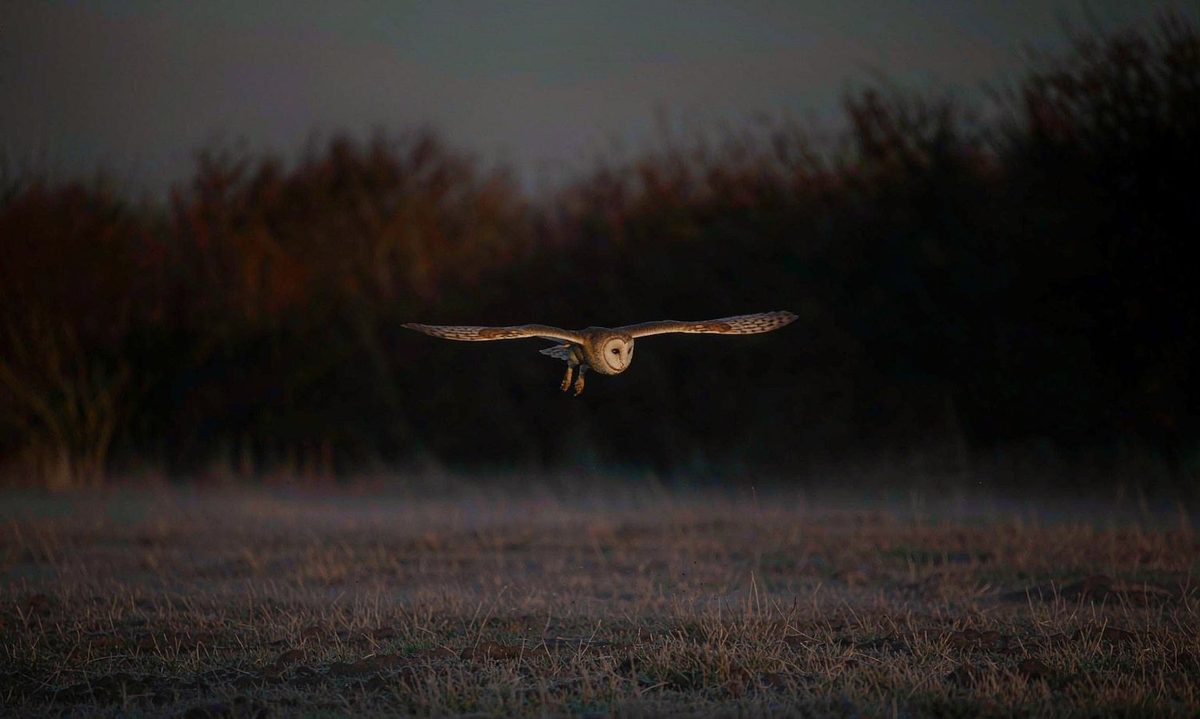
A barn owl quartering a meadow at dusk is doing something that ought to be audible from thirty metres away. It is not. The wing beats about three times a second, each stroke sweeping a surface wider than a dinner plate through still air, and the vole it is hunting has ears tuned to exactly the low-frequency thump that kind of motion should make. The vole hears the wind, the grass, its own chewing. Then the talons arrive.
I have gone back to the acoustics papers on this more than once, and what keeps me there is not the silence itself but how much of it is structural. An owl wing is not a quieter version of a pigeon wing. It is a wing with three separate pieces of engineering added to it, each one aimed at a different source of noise, and all three of them sit in the last two millimetres of the feather.
Where flight noise actually comes from
Most of the sound a bird makes comes from two places, and neither is the flapping.
The first is the trailing edge. Air travelling over the top of a wing is moving faster than air underneath, so the two streams meet at the back edge with different pressures. Where a fast stream and a slow stream are forced together at a sharp line, the shear layer rolls up into vortices at a fairly regular frequency, and those vortices radiate sound. The sharper and more rigid the edge, the cleaner the shedding and the louder the tone.
The second is the leading edge. Any turbulence already in the air — and at dusk, over a field, there is plenty — hits the front of the wing and is amplified. The wing scatters that incoming turbulence into sound the way a rock scatters a wave.
A third contribution comes from the boundary layer, the thin skin of slowed air dragging across the surface.
Owls attack all three. That is the part I find worth explaining, because the popular account usually stops at "serrated feathers" and serrations are only one of four things going on.
Four changes, not one
The first is size. Barn owl wing loading is around 33 newtons per square metre, low for a bird of that mass, and across fifteen North American owl species the range runs from roughly 19 to 60. Low wing loading buys slow flight, and aerodynamic noise rises steeply with speed. Half the trick is simply not going fast.
The second is the leading-edge comb. On the outermost primary feathers, the tips of the barbs stand free instead of zipping together into a smooth vane, so the front edge of the wing looks like a plastic comb with teeth a millimetre or two long. Air arriving at the wing meets a row of small obstacles rather than a single hard line.
The third is the surface. Run a finger along the top of an owl's wing and it feels like felt. The barbules, the fine branches that normally hook together to make a feather flat, end in long soft extensions called pennula instead of ending in hooks. The wing has, in effect, a porous fleece lying on it.
The fourth is the trailing edge, which is not an edge at all but a soft fringe between one and four and a half millimetres deep, made of the same loose barbules. Instead of the two airstreams colliding at a line, they meet across a gradient.
12px;orphans:2;text-align:start;text-decoration-color:initial;text-decoration-style:initial;text-decoration-thickness:initial;text-indent:0px;text-transform:none;white-space:normal;widows:2;word-spacing:0px;" data-page-node-id="IQfmDNDx3EfegLk4GhLHQ6" data-dm-ref="22">What each piece is doing
The fringe is the easiest to explain. Trailing-edge noise is generated when two flows of different speed are forced to merge at a discontinuity. A fringe removes the discontinuity. Laboratory models of fringed trailing edges have produced reductions of up to about ten decibels at gliding speeds, which on a logarithmic scale is a large change in perceived loudness.
The comb is subtler and, honestly, more contested. A 2024 study built a physical model of the comb from three-dimensional micro-scans of actual barn owl barb rows, put it in a flow channel, and measured the wake with particle image velocimetry. In smooth inflow the serrations produced regular velocity streaks and turned the flow slightly. When turbulence was added upstream, the serrations reduced the fluctuations downstream, and the reduction was strongest in the spanwise component — the flow came out more uniform than it went in. The authors read that as passive flow control: the comb does not absorb sound, it prevents the wing from generating as much.
The velvet is the least intuitive. A porous, hairy surface is normally a bad idea aerodynamically, because roughness trips the boundary layer into turbulence. On an owl wing at the low Reynolds numbers these birds fly at, the pennula appear to do the opposite: they keep the flow attached at lower speeds, which allows the bird to fly more slowly still, and they absorb some of the high-frequency sound that the surface would otherwise reflect.
The part the papers do not settle
Which of the four matters most is not established. Wind-tunnel results depend on angle of attack, and the serration benefit in particular has been reported as strongly positive in some studies and marginal in others. Measurements on flying birds are hard; measurements on models are clean but model the feather badly. Owls are also not silent. They are quiet, in a frequency band and at a distance that matters to a vole, which is a different and more interesting claim.
There is a further wrinkle: feather wear. Fringes fray, combs break, and a captive owl on a hard perch has a different wing from a wild one. The structure is not maintained by anything except replacement at moult, which means the quietest wing in a collection is usually the newest.
What a feather looks like up close
A flight feather is a branching hierarchy, and once you see the hierarchy the owl's modifications stop looking like magic and start looking like edits.
A central shaft, the rachis, carries two rows of barbs. Each barb carries two rows of barbules. Each barbule carries tiny hooks, the hamuli, which catch the curled barbules of the neighbouring barb and zip the whole vane into a continuous sheet. The zipper is not glued; it is mechanically interlocked, and a bird spends time every day re-zipping it with its beak.
On a pigeon feather, the barbs at the leading edge are zipped and the barbules at the trailing edge end in hooks. On an owl feather, the leading barbs are unzipped for the last millimetre or two, the dorsal barbules end in long filaments, and the trailing barbules have no hooks at all. Same parts, different terminal geometry, three acoustic consequences.
This is the kind of comparison a virtual microscope is good at, because the difference is not visible at arm's length. At low magnification a feather is a dark blade. At higher magnification it becomes a comb, a felt, a fringe, and the reason a vole dies without hearing anything.

Comparative anatomy is mostly a habit of looking at the same structure twice, at a scale where the differences are visible. Wwai pairs a scanned slide library with an AI lab partner, so a feather, a leaf or a tissue section can be worked through at high magnification and set beside a second specimen.