The first time I touched a trigger hair inside a Venus flytrap, nothing happened. The trap sat there, half open, insultingly inert. The second touch, a few seconds later, produced a snap fast enough to be startling. I had read that the plant needs two touches. What I had not appreciated was that the plant is not waiting for two touches at all. It is waiting for a concentration of calcium to cross a threshold, and the touches are just the pump.
That distinction sounds like pedantry until you look at what happens after the trap closes, because the counting does not stop.
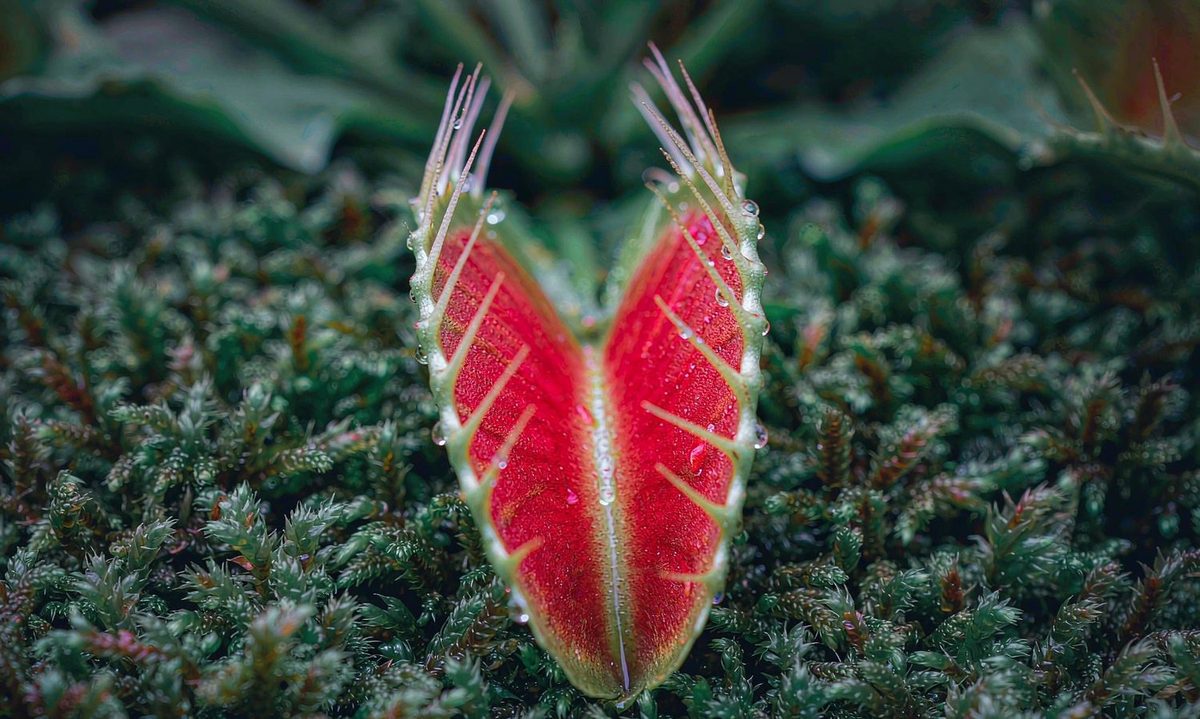
Two signals, half a minute
Each trigger hair sits in a small pit on the inner surface of the lobe. Deflect it and a receptor potential builds at the base, and if the deflection is large enough the trap fires an action potential — a genuine electrical spike, propagating across the lobe the way a nerve impulse propagates along an axon, though the machinery is different.
Two action potentials within roughly half a minute close the trap. A second stimulus that arrives too late does nothing, because the first one has already faded. That is not a decision, it is a decay constant.
The mechanism was nailed down in 2020 by a team that engineered the plant to express a fluorescent calcium sensor. When a trigger hair was touched, the cells at its base lit up, and the glow spread across the trap as a wave, peaked within seconds, and was largely gone inside a minute. A second touch arriving before the wave had decayed added to what was left of the first, and when the summed calcium crossed a threshold the lobes snapped shut. The plant is not counting. It is integrating, with a leak.
The rule is not as clean as the rule of thumb
Two touches in thirty seconds is the standard statement, and it is a good approximation of a messier reality. A 2020 study using a force-sensing microrobotic system found that a single sufficiently fast deflection can produce two action potentials on its own, because the mechanical relaxation of the hair triggers a second spike. Under those conditions one touch is enough.
That reframes the whole performance. The plant is not running a verification protocol with a counter. It is running a mechanical filter that is tuned to the frequency content of a struggling insect and not to the impact of a raindrop. A raindrop delivers one impulse with a fast decay. A beetle delivers repeated impulses. The threshold does the discriminating; the "counting" is what we call it afterwards.
What happens after the trap shuts
Here is the part that changed how I think about the plant. Closing is cheap compared with digesting, and digestion is expensive. A trap that fires its glands for every falling twig would spend itself in a week.
So the plant keeps counting. In the 2016 experiments that established this, the touch hormone jasmonic acid signalling switched on after the second action potential. More than three action potentials were needed before the genes for prey-degrading hydrolases began to be expressed, and the level of expression scaled with the number of stimuli rather than switching on at a fixed point. At five action potentials, the repressor JAZ1 peaked at several times its resting level, and the transcript for a sodium channel called DmHKT1 rose as much as sixty-fold.
The sodium channel is the elegant detail. A plant has no dietary requirement for sodium in the way an animal does, but it does need ions for electrical signalling, and animal prey is a sodium delivery system. The trap takes up sodium through its glands after a meal — roughly doubling the sodium content of the capture organ within a day — and the number of action potentials is what tells the gland cells how much sodium to expect.
None of this is anticipation. It is a plant reading the duration of a struggle and provisioning accordingly. In a recording from a captured cricket, the trap registered fifty-one action potentials in the first hour.
Why a plant needs a nervous system it does not have
Plants do not have neurons, and the action potential in a flytrap is not the same thing as an action potential in a mammal. There is no sodium-driven spike in most plant cells; the depolarisation runs on chloride and calcium fluxes, and it travels through the vascular tissue and the parenchyma rather than along a dedicated cable.
But the functional logic is recognisably neural: a receptor, a threshold, a propagating signal, a memory with a time constant, and a downstream transcriptional response that depends on how many signals arrived. The 2020 calcium imaging makes the memory concrete — it is a molecule with a half-life, sitting in the cells of the trap.
What the plant lacks is a place to put the information. A nervous system centralises; the flytrap distributes. Every lobe does its own arithmetic.
What the leaf looks like under the scope
A flytrap lobe in section is a sandwich of largely undifferentiated parenchyma with an upper and lower epidermis, and the interesting parts are all at the surfaces. On the inner face, the glands that secrete the digestive cocktail sit in dense red patches, tens of thousands of them across a single trap. Each gland is a small multicellular structure with a secretory head and a stalk, and it does two jobs that are usually separated in an animal: it releases acid and enzymes outward, and it absorbs the products back in.
The trigger hair is a different kind of object. It is a stiff conical projection with a flexible base, and the sensory cells sit in the pit where it hinges, not in the hair itself. That geometry is the whole design: a long lever, a small hinge, a few cells that can detect a few degrees of bend.
The third structure worth looking for is the midrib, the hinge of the trap. Its cells change shape when the trap fires, and the curvature it produces is what flips the lobe from convex to concave — a snap-buckling event, not a slow contraction. Students who look for a muscle there will not find one, which is the lesson.
Carnivorous plants reward close looking, because the structures that make the argument are all microscopic: a hinge, a gland, a sensory pit. Wwai runs a scanned slide library alongside an AI lab partner, so a leaf section can be read at cell level while the physiology of the whole organ stays in view.
