There is a particular kind of crying that has no interior life at all. You are standing at a board at nine at night, knife in hand, and your eyes start streaming while your mood is entirely neutral. Nothing is sad. Nothing is even interesting. A vegetable has persuaded your lacrimal glands to run, and it did it without touching your eye.
That last point is the one worth pulling on. The onion does not squirt anything at you. It releases a gas, the gas diffuses through the air, the gas reaches the surface of your cornea, and your own nervous system does the rest. The tears are a reflex you own, triggered by a molecule the plant built for a different purpose.
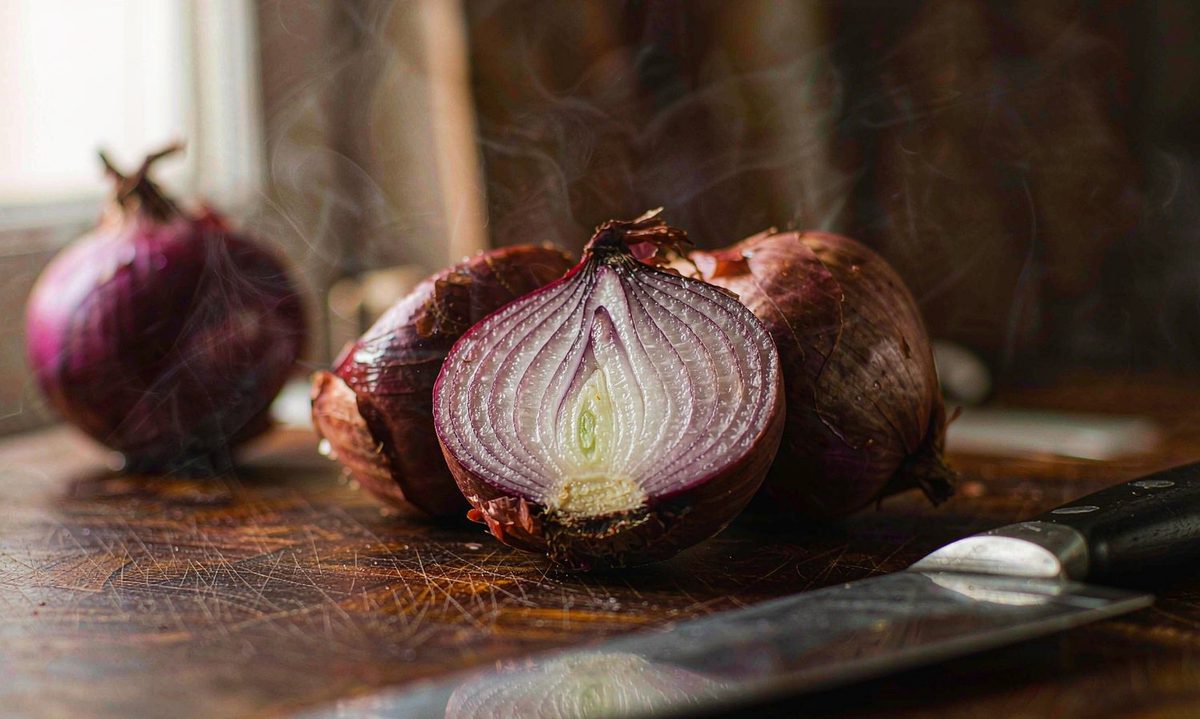
Two compartments that should never have met
An intact onion cell keeps its chemistry in separate rooms. The cytoplasm holds a class of sulfur compounds called cysteine sulfoxides, of which the relevant one in onion is isoalliin, also written PRENCSO. The vacuole — the large storage compartment that gives plant cells most of their volume — holds an enzyme called alliinase.
As long as the cell is intact, the two do not meet. A knife blade changes that. Cut into the tissue and you rupture cells along the cut, the vacuole membrane fails, alliinase meets isoalliin, and the enzyme removes a chemical group to leave a short-lived intermediate called a sulfenic acid. This is the same first step that gives garlic its bite, and in garlic the sulfenic acid goes on to condense into allicin, the stable compound that gives crushed garlic its smell and its antimicrobial reputation.
The onion does something different with the same intermediate. It has an enzyme, lachrymatory factor synthase, that grabs the sulfenic acid and rearranges it into propanethial S-oxide, a small volatile sulfur compound that leaves the tissue as a gas within seconds. The reaction also releases pyruvate and ammonia, which is part of why a cut onion smells sharp rather than merely sulfury.
The enzyme was identified in 2002, which is later than most people assume for something this familiar. A Japanese group purified it and showed that suppressing it pushed the same intermediate back toward stable thiosulfinates and stopped the tearing — the first clean demonstration that the sting in the eye and the taste on the tongue come from different branches of the same pathway. The crystal structure followed in 2019, and the simulations that came with it showed the rearrangement happening through a proton shuttle rather than a slow multi-step cascade, which is why the gas appears so fast.
Why the plant bothers
The standard answer is defence, and it is probably right. Volatile sulfur compounds are toxic to plenty of things that would otherwise eat a bulb, and a compound that makes an animal's eyes water is a compound that makes the animal stop chewing and back away.
But there is a wrinkle. The lachrymatory factor is volatile, which makes it a poor long-term antimicrobial — it leaves. Garlic's allicin stays. So the onion lineage, which shares the same starting chemistry, has an enzyme that actively diverts the intermediate away from the stable antimicrobial product and toward a gas that disperses. One reading is that the onion traded persistence for immediate deterrence; another is that the diversion protects the plant's own tissue from its own chemistry. The literature leans toward deterrence, but not decisively.
Where your tears come from
18px;orphans:2;text-align:start;text-decoration-color:initial;text-decoration-style:initial;text-decoration-thickness:initial;text-indent:0px;text-transform:none;white-space:normal;widows:2;word-spacing:0px;" data-page-node-id="eKGjAPvGGRv4VAWRQbElya" data-dm-ref="20">The cornea is one of the most densely innervated surfaces in the body. It has no blood vessels, so the nerve endings that detect damage have to be numerous to compensate, and they are branches of the ophthalmic division of the trigeminal nerve.
Propanethial S-oxide is electrophilic and reacts with thiol groups on proteins. On the corneal surface it does what irritants do: it activates nociceptors, and the signal travels back along the trigeminal to the brainstem. The brainstem does not consult your feelings. It sends parasympathetic fibres out along the facial nerve to the lacrimal gland, and the gland secretes.
This is a reflex tear, and it differs from an emotional one. Reflex tears are mostly water and salt with lysozyme and other antimicrobial proteins, produced in volume to flush the surface. Emotional tears carry more protein and more of certain hormones, and they are driven by a different route, from the limbic system down. Both come out of the same gland, which is why the two feel similar and are chemically not the same fluid. It also explains why the onion trick works on people who are not sad and fails on people who have had their lacrimal nerve damaged.
Why the reflex cannot win
The design has an obvious flaw, which is why the experience is unpleasant rather than merely surprising. The reflex is a flushing response, evolved for a foreign body on the eye — a bit of grit, an insect. Flushing works because the irritant is finite.
A cut onion is neither. It keeps producing gas for as long as you keep cutting, and the gas arrives from the air rather than from the eye, so the surface is re-contaminated continuously. You are flushing a room that is still on fire. Meanwhile the gas is also reaching the nasal mucosa, which triggers the same kind of reflex through a different branch and adds the runny nose that nobody warns you about.
The practical measures all attack one of the two steps. A sharp knife ruptures fewer cells, so less enzyme meets substrate. A cold onion slows the enzyme, so the gas is released more slowly. A bowl of water near the board captures part of the volatile before it rises. None of them stops the chemistry, because the chemistry is what an onion is.
What you see on the slide
Onion epidermis is the most photographed specimen in the history of biology teaching, and the reason is practical: the inner surface of a scale leaf peels off in a sheet one cell thick, so you get a monolayer of large, brick-shaped cells with no sectioning and no staining required.
Under a light microscope the cells read as a regular grid of walls with a nucleus pushed to one side and a large clear space where the vacuole sits. What the standard exercise usually does not emphasise is that the clear space is the compartment holding the enzyme, and the thin layer of cytoplasm against the wall is where the substrate is. The slide you are looking at is a map of two chemicals that are being kept apart by a membrane you cannot see at that magnification.
The other thing worth doing with that specimen is comparing it with garlic. The cells look similar, the walls look similar, and yet the same starting compound ends in a stable antimicrobial in one tissue and a tear gas in the other, because of one enzyme. That is the whole argument for comparative cell work in a single pair of slides.

The interesting differences in biology are usually one enzyme apart, and you only see them by putting two specimens side by side. Wwai pairs a scanned slide library with an AI lab partner, so plant tissue can be compared at cell level while the pathway behind the difference stays in view.