A cotton swab is not a diagnostic instrument, but for one trait it is close. Earwax comes in two broad consistencies — wet, sticky and yellowish-brown, or dry, flaky and grey — and the difference is decided almost entirely by a single base pair in a single gene. If your earwax is dry, you are almost certainly homozygous for one variant. If it is wet, you carry at least one copy of the other.
That is striking. Most traits people describe as binary turn out to be a gradient produced by dozens of genes and a lifetime of environment. Earwax is an exception: one locus, two alleles, a large effect, and a phenotype you can check in ten seconds.
One base pair
The gene is ABCC11, on the long arm of chromosome 16. It encodes a protein of the ATP-binding cassette family, which in general are pumps: they move molecules across membranes using ATP. ABCC11 is expressed in a small set of secretory tissues — the apocrine sweat glands of the axilla, the ceruminous glands of the ear canal, and the mammary gland.
The variant that matters is a G-to-A substitution, rs17822931, at position 538 of the coding sequence. The A allele produces a protein that does not function as a transporter. The G allele produces a working one. Individuals with two A alleles have dry earwax; individuals with one or two G alleles have wet earwax.
The genetics was pinned down in 2006, in a study that also linked earwax type to apocrine output tightly enough that one can proxy for the other.
What the pump is actually moving
The reason the two traits are linked is that they are the same tissue type doing the same job in two places. Apocrine glands are the large glands associated with hair follicles in the axilla and groin; ceruminous glands in the ear canal are a modified version of the same thing. Both produce a secretion that is initially odourless.
Odour comes later, and it comes from bacteria. The apocrine secretion contains amino acid conjugates — precursors such as 3M2H bound to glutamine — that are not volatile and do not smell. Corynebacterium species in the axilla carry an enzyme that cleaves the conjugate and releases the volatile acid, and Staphylococcus hominis contributes related conversions. The characteristic sharp, sulfurous note of body odour is largely a bacterial product, made in situ from a substrate the gland supplied.
ABCC11 loads those conjugates into the secretion. Lose the transporter and the substrate is not delivered, so there is nothing for the bacteria to convert; the gland still secretes, but the raw material is missing.
That is why the A allele produces both a dry ear canal and a low-odour axilla, and why it is misleading to say the gene "causes" body odour. It sets the substrate concentration. The microbiome, gland density, hair, skin pH and hygiene do the rest, which is why two people with identical genotypes can smell quite different.
The map
The allele frequencies are among the steepest of any common human variant, and they are the reason deodorant is a bigger industry in some countries than others.
In East Asian populations the dry-type A allele is close to fixation: roughly 80 to 95 per cent of people are A/A depending on the population sampled, with Han Chinese, Japanese and Korean populations at the high end. In European and African populations the pattern inverts — the wet-type G allele predominates and the A/A genotype is a few per cent. Southeast Asia and South Asia sit in between, and Indigenous American populations are variable, with some groups showing high frequencies consistent with an ancestral East Asian source.
Because the trait is one gene with a visible phenotype, it has been used as a marker in population genetics for decades, which is worth being careful about. A frequency difference between populations is a fact about populations, not a statement about individuals or about the validity of grouping people by appearance. Allele frequencies vary continuously across geography, and the within-population variance is larger than most people expect.
Why East Asia, and why nobody agrees
The obvious question is why a loss-of-function variant in a secretory transporter would rise to near-fixation across a large part of one continent.
There are three families of explanation, and none of them is settled. The first is natural selection, in several flavours: reduced body odour might have reduced detection by predators or parasites, or it might have interacted with sexual selection and social signalling. The second is genetic drift and founder effects during the peopling of East Asia, which can fix a variant in a small founding population without any advantage at all. The third is a secondary consequence — the same allele affects the composition of breast milk lipids and possibly other secretions, so selection on one function could drag the other along.
The honest summary is that the pattern is well documented and the cause is not. I would rather say that in a class than pick the most appealing story, because the most appealing story here is also the least testable.
What the gene does beyond earwax
ABCC11 has a second life in pharmacology. It is a transporter with a broad substrate range, and it is expressed in breast tissue, which has made it a candidate in studies of how certain drugs are handled by tumours. The literature on this is real but uneven, and I would not draw a conclusion from it beyond the general point that transporters named for one trait often turn out to do several jobs.
There is also a practical clinical use. Because earwax type tracks apocrine function closely, it can serve as a cheap screen before considering more invasive treatment for axillary osmidrosis: a dry phenotype makes a strong contribution from that gland unlikely.
What the gland looks like
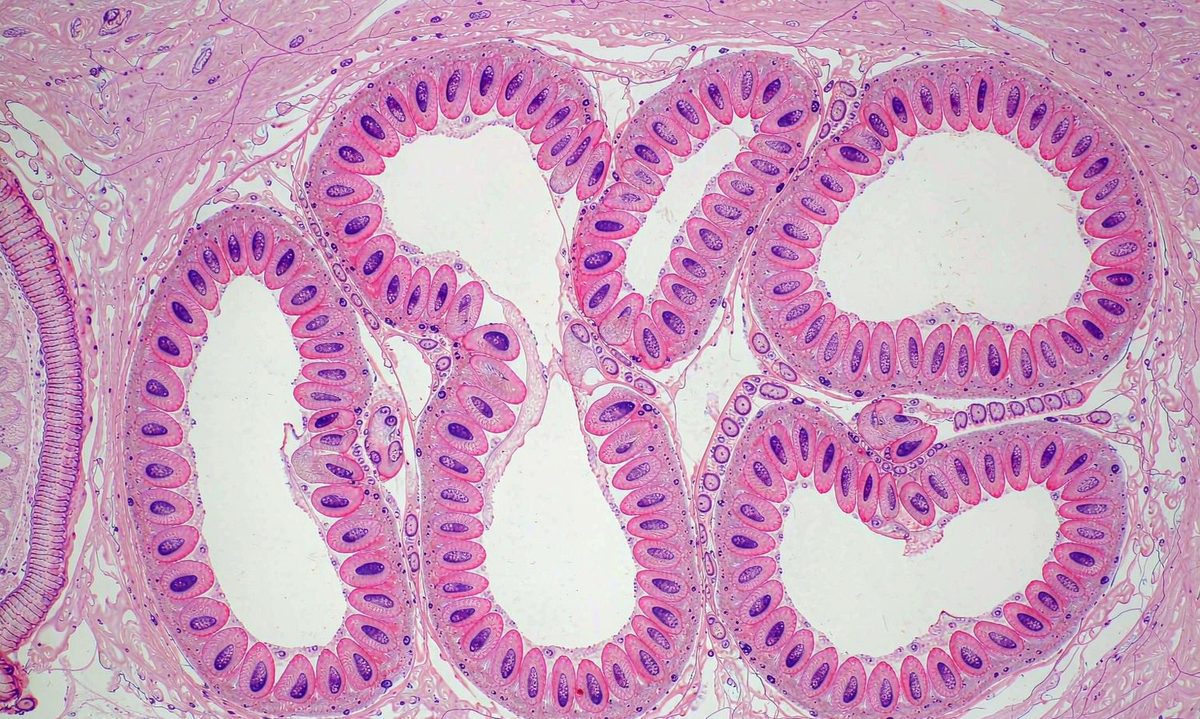
The histology is where the two traits visibly converge. In axillary skin, apocrine glands sit deep in the dermis, usually associated with a hair follicle into which they empty. Their lumen is large — much larger than the eccrine sweat glands nearby — and the epithelium is a single layer of columnar cells whose apical cytoplasm pinches off into the lumen, a process called decapitation secretion. That blebbing is the morphological signature of an apocrine gland, and it is the reason the secretion is rich in protein and lipid rather than being a filtrate.
The ceruminous glands of the ear canal are a smaller version of the same structure, and the wax is a mixture of glandular secretion, sebum, desquamated keratinocytes and debris. A smear of it is mostly amorphous lipid and keratin flakes; the gland that made it is the interesting object.
The comparison worth making on a slide is between the three skin gland types: eccrine, apocrine, and sebaceous. They sit within a millimetre of each other, they look different, they secrete differently, and only one of them responds to a single base pair in a transporter gene.
Histology is where a genetic claim becomes checkable: a transporter variant matters because a particular gland in a particular place secretes a particular way. Wwai pairs a scanned slide library with an AI lab partner, so skin and gland sections can be compared at cell level while the genetics stays attached to the tissue.
