A dry, rigid block of instant noodles can turn into soft, springy strands after just a few minutes in boiling water.
The process seems simple: boil some water, add the noodles, stir in the seasoning, and a steaming bowl of noodles is ready to eat.
In the latest episode of Chubby Cat Kitchen, two cats bring home a pack of spicy Korean instant noodles from a convenience store and prepare them in their countryside kitchen.
But beyond the finished dish, something interesting happens during cooking.
Why do ordinary dried noodles often take longer to cook, while instant noodles can be ready in just a few minutes? What exactly happens inside those dry, tightly packed strands when they come into contact with hot water?
The answer lies in how instant noodles are manufactured and in one of the most important components of wheat flour: starch.
[VIDEO: Convenience Store Shopping and Spicy Noodle Preparation]
01 | Why Can Instant Noodles Be Ready in Just a Few Minutes?
Instant noodles are typically made from wheat flour, which contains substantial amounts of starch along with proteins.
Unlike many conventional dried noodles, instant noodles usually undergo a heat-treatment process during manufacturing.
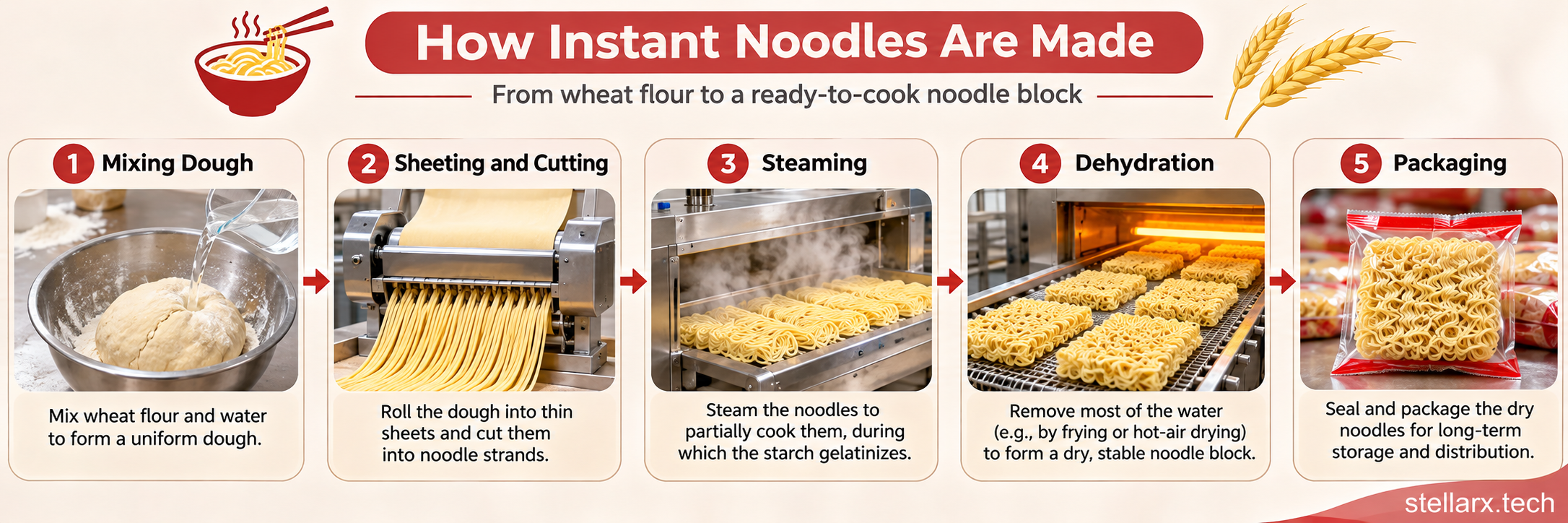
For common fried instant noodles, the process begins with mixing wheat flour and water, followed by sheeting and cutting the dough into strands.
The noodles are then steamed before being dehydrated through frying.
Non-fried instant noodles also commonly undergo steaming and hot-air drying, although the exact manufacturing process varies between products.
During steaming, heat and moisture cause starch gelatinization.
As this happens, some of the ordered molecular structures within starch granules are disrupted, allowing the granules to absorb water and swell.
The subsequent dehydration process significantly reduces the moisture content of the noodles, producing a dry block that is easier to store and transport.
This means that the instant noodles we purchase are not simply raw noodles that have never been heated.
They have generally undergone heat treatment and dehydration. During preparation, they primarily need to reabsorb water and be heated to a suitable eating condition.
This is one of the main reasons many instant noodles can be prepared so quickly.
[IMAGE 1: Instant Noodle Manufacturing Process — Mixing, Sheeting and Cutting, Steaming, Dehydration, and Packaging]
02 | Why Do Dry Noodles Become Soft in Hot Water?
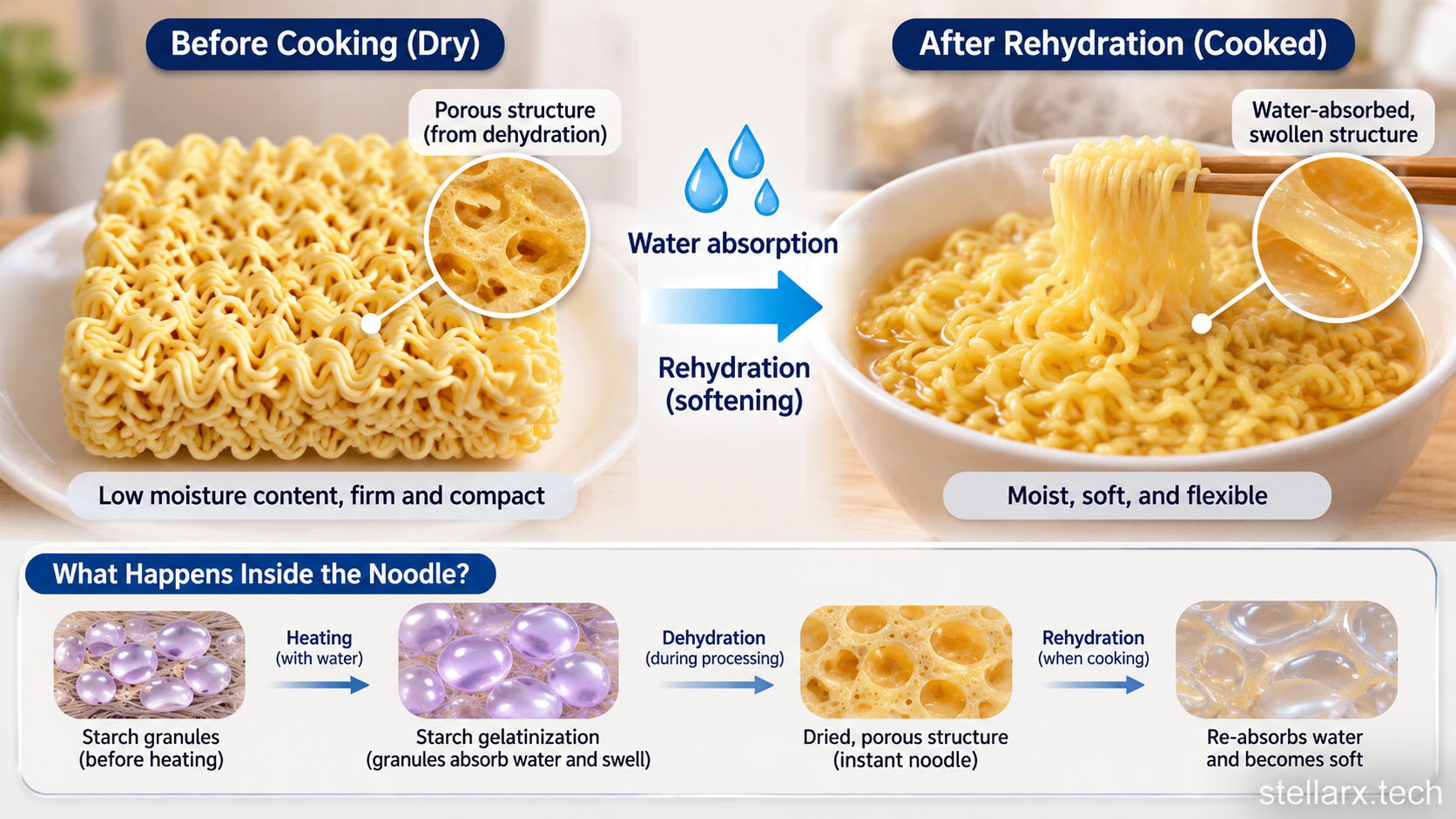
When instant noodles are placed in boiling water, the most noticeable change is that the compact noodle block gradually loosens.
The strands become softer and more flexible as cooking continues.
This transformation is largely caused by water entering the noodles.
In their dried state, instant noodles contain relatively little moisture. The structure formed by starch and proteins contributes to their firmness.
When the noodles come into contact with hot water, moisture begins to penetrate from the surface toward the interior.
As water absorption continues, the starch-protein system undergoes physical changes, allowing the previously dry and rigid structure to become more flexible.
Hot water also accelerates moisture penetration, helping the noodles soften more quickly.
However, not all instant noodles rehydrate at the same rate.
Factors such as noodle thickness, pore structure, processing methods, and water temperature can influence how efficiently water moves into the noodles.
For example, fried instant noodles typically develop a porous structure during dehydration, which can facilitate water absorption during cooking.
The rehydration characteristics of non-fried instant noodles depend on their specific manufacturing processes and structural properties.
These differences help explain why some instant noodles can be prepared by soaking them in hot water for a few minutes, while others require continued boiling to achieve the desired texture.
[IMAGE 2: Comparison of Instant Noodles Before and After Rehydration]
03 | Where Does the Starch in Noodles Come From?
The ability of instant noodles to absorb water and change texture is closely related to their main ingredient: wheat flour.
But the starch found in wheat flour originally comes from the biological processes of plants.
Through photosynthesis, plants use light energy to convert carbon dioxide and water into organic compounds.
Some of these compounds support growth and metabolism, while others can be converted into storage substances such as starch.
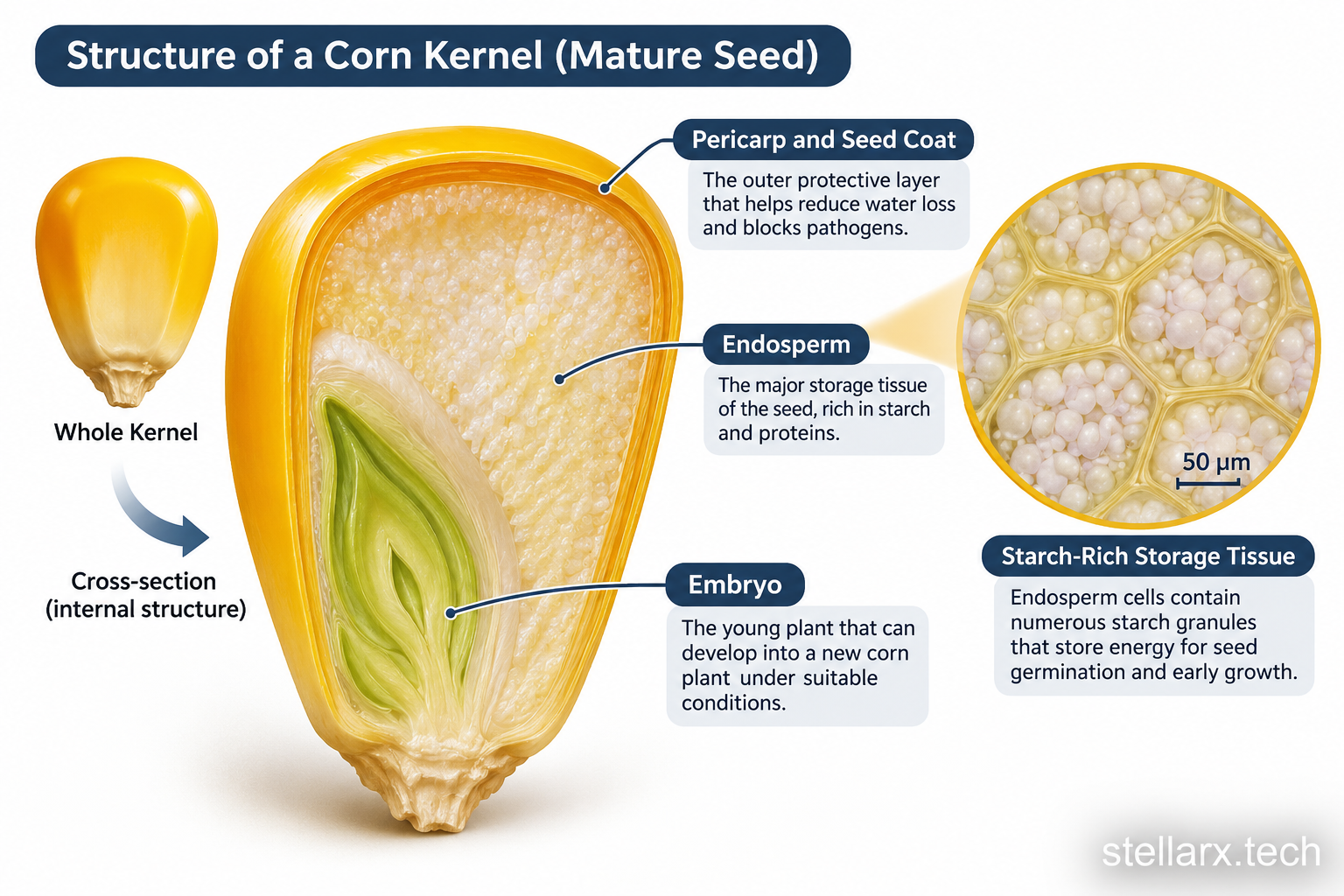
In cereal crops such as wheat, rice, and corn, seeds serve as important nutrient-storage structures.
In wheat, for example, the endosperm contains substantial amounts of starch and is the primary source of conventional wheat flour.
Within plant cells, starch is generally stored in the form of starch granules.